Middle East Airspace Restrictions Add Pressure on Indian Airlines
By Bilal Haider :
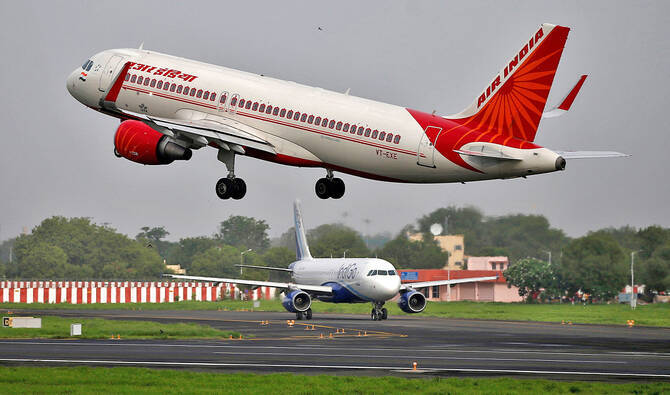
Airspace closures across the Middle East due to the ongoing conflict with Iran have created fresh challenges for Indian airlines, which already face restrictions after Pakistan barred them from using its airspace last year.
The disruption has forced carriers to cancel or reroute a large number of international flights, particularly on routes connecting India to Europe, North America and the Gulf region.
According to aviation data firm Cirium, India’s largest international carriers Air India and IndiGo did not operate about 64% of their scheduled flights to the Middle East, Europe and North America over the past 10 days.
Aviation analyst Amit Mittal described the situation as a “double setback” for Indian airlines operating long-haul routes.
Pakistan has barred Indian carriers from flying through its airspace since April last year following tensions between the two countries, forcing airlines to take longer routes even before the current Middle East crisis.
Longer routes and higher costs
With airspace restrictions now expanding across parts of the Middle East, airlines have been left with limited alternatives.
Analysts at HSBC said the geopolitical tensions could place a “significant burden” on airline profitability. The bank estimates that just seven days of cancellations could reduce annual profit forecasts by around 1.2%.
For IndiGo, the disruption has been particularly complicated. The airline relies on six long-range aircraft leased from Norse Atlantic Airways to operate routes to Europe.
Because the aircraft remain registered in Norway, they must follow safety guidance issued by the European Union Aviation Safety Agency, which has advised airlines to avoid airspace over several countries including Iran, Iraq, Israel, Qatar, United Arab Emirates, Kuwait, Lebanon, and Saudi Arabia.
As a result, IndiGo has been forced to divert flights via Africa, increasing journey times by up to two hours, according to flight tracking service Flightradar24.
Flight disruptions continue
Operational complications have also emerged along these alternative routes.
A Delhi–Manchester flight operated by IndiGo was forced to return to Delhi after air traffic authorities in Eritrea denied permission for the aircraft to pass through its airspace.
The plane remained in the air for around 13 hours before returning to Delhi, with the airline citing last-minute airspace restrictions.
Another IndiGo aircraft travelling from London to Mumbai was forced to divert to Cairo due to similar issues.
Air India adjusts operations
Meanwhile, Air India said it plans to add 78 extra flights between India and Europe and the United States over the coming week to meet passenger demand.
However, longer flight paths are extending travel times. A recent Delhi–New York service made a stop in Rome, stretching the journey to nearly 22 hours. Before the conflict, flights could reach the United States in about 17 hours via airspace over Iraq and Turkey.
By comparison, a flight operated by American Airlines on the same route took around 16 hours as it was able to fly over Pakistan.
Industry observers say longer routes increase fuel consumption and operational costs, a challenge that has intensified as oil prices rise during the ongoing conflict.
Air India, which is owned by Tata Group and Singapore Airlines, has previously estimated that the Pakistan airspace ban alone could cost it about $600m annually.
With energy prices rising and flight times increasing, analysts say the combined impact of geopolitical tensions and airspace restrictions could continue to weigh heavily on the airline industry.
About Author