Middle East War Escalates as Trump Threatens New Strikes on Iran
By Sabeeh Zanair :
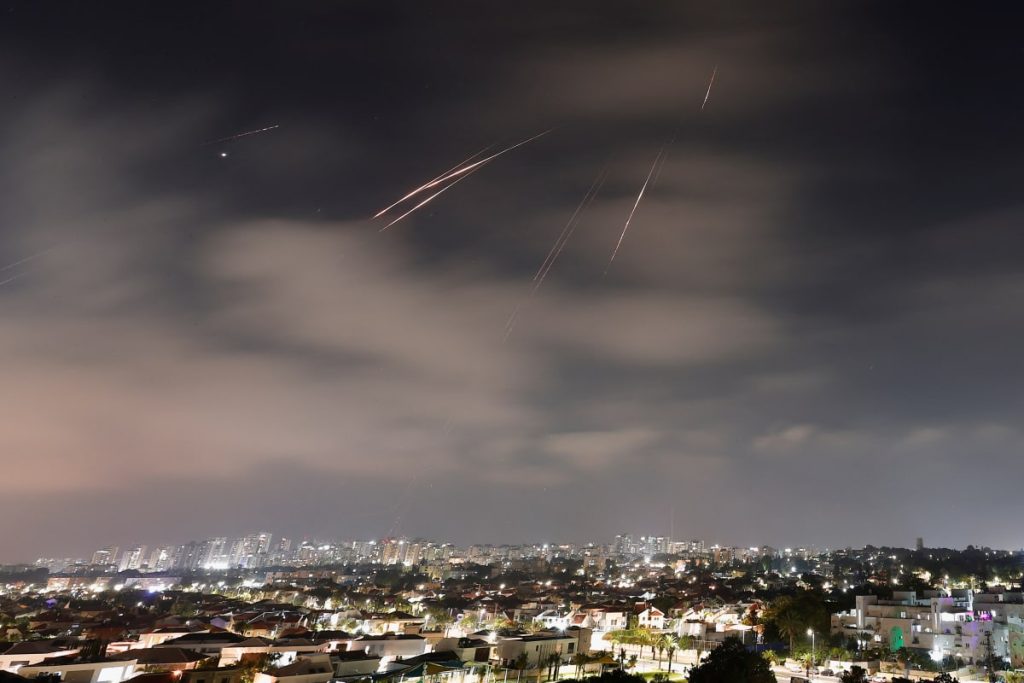
Tensions across the Middle East intensified further as the war launched by the United States and Israel against Iran entered its second week, with both sides exchanging threats and missile attacks across the region.
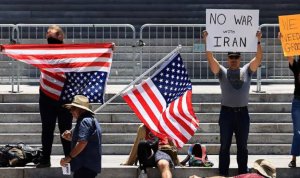
Donald Trump warned that Iran could face “very hard” strikes, while Iranian leaders insisted they would not surrender to foreign pressure and vowed continued retaliation if attacks persist.
Iran rejects ‘unconditional surrender’
Iranian President Masoud Pezeshkian said Tehran would not target neighbouring countries unless attacks originated from their territory, rejecting Trump’s demand for “unconditional surrender”.
Speaking as Iranian drones and missiles continued to strike targets in Israel and parts of the Gulf, Pezeshkian said Iran’s actions were directed primarily at US military installations rather than regional states.
“Iran’s actions target US military bases, facilities and installations, not neighbouring countries,” he said.
Iran’s powerful military force, the Islamic Revolutionary Guard Corps (IRGC), warned that if the attacks on Iran continue, all US and Israeli military bases and interests across the region would become legitimate targets.
Trump issues fresh threat
Trump escalated the rhetoric on Saturday, warning that Iran could soon face devastating military action.
“Today Iran will be hit very hard,” the US president said, adding that certain locations and groups that had previously been spared could now face destruction.
He also claimed that US forces had destroyed 42 Iranian warships in three days, although Iranian officials did not confirm the claim.
Meanwhile, an Iranian army spokesman warned that any hostile naval vessels entering the Gulf would end up “at the bottom of the sea”.
Missile strikes across Israel
Air raid sirens sounded across major Israeli cities including Jerusalem, Tel Aviv and Haifa as Iran launched new missile attacks.
The IRGC said the strikes involved advanced solid-fuel Kheibar Shekan missiles, which it described as capable of precision guided attacks on strategic targets.
Heavy casualties in Lebanon
The conflict has also intensified in Lebanon, where Israeli air and ground raids killed at least 41 people in the town of Nabi Chit in the eastern Bekaa Valley.
Lebanon’s health ministry said the overall death toll from Israeli strikes since Monday had climbed to 294 people, with more than 1,000 injured.
Israeli forces also launched a rare airborne operation near Nabi Chit involving helicopter-borne troops.
The Israeli military said the operation was aimed at locating the remains of missing navigator Ron Arad, who disappeared in Lebanon in 1986. However, the search reportedly did not recover any new evidence.
Residents described the overnight bombardment as extremely intense.
“It was a night of hell,” said Shawki Al-Masri, a resident of a nearby town, describing helicopters flying low overhead and heavy airstrikes that lasted until morning.
Saudi Arabia intercepts missiles
In Saudi Arabia, air defence systems intercepted two ballistic missiles targeting the Prince Sultan Air Base as well as drones aimed at the Shaybah oilfield.
Saudi officials confirmed that the missiles landed in uninhabited areas after being destroyed.
Explosions reported in Iraq
Explosions were also reported in Iraq, including near the heavily fortified Green Zone, which houses the US embassy in Baghdad.
In the northern Kurdish city of Erbil, journalists reported hearing at least three loud explosions after drones were spotted in the sky.
UAE says nation prepared
President Mohammed bin Zayed Al Nahyan addressed the nation in the United Arab Emirates, declaring that the country was prepared to defend itself amid the widening conflict.
“The UAE has thick skin and bitter flesh — we are no easy prey,” he said, assuring residents and foreign nationals of their safety.
Iran has previously launched missile and drone strikes targeting Gulf states hosting US military bases.
Diplomatic concerns grow
Regional leaders warned that the escalating conflict posed serious risks to stability across the Middle East.
Hakan Fidan, the foreign minister of Turkiye, cautioned that the developments threatened regional peace and security.
Meanwhile, Iran began evacuating embassy families and civilians from some countries, including Lebanon, following Israeli warnings directed at Iranian personnel in Beirut.
Iran leadership transition underway
The conflict comes amid a leadership transition in Iran following the killing of Supreme Leader Ali Khamenei in the initial US-Israeli strikes.
Under Iran’s constitution, a temporary leadership council composed of the president, a senior cleric and the judiciary chief has taken charge until a new leader is selected.
Senior clerics including Naser Makarem Shirazi and Hossein Nouri Hamedani have called on the 88-member Assembly of Experts to accelerate the process of appointing a successor.
Iranian officials said the selection could take place within the constitutionally mandated three-month period, though wartime conditions may complicate the process.
Oil markets shaken
The war has also begun to disrupt global energy supplies.
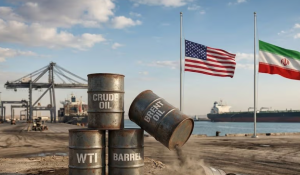
Kuwait Petroleum Corporation announced it had cut crude oil production and declared force majeure after threats to shipping routes in the Strait of Hormuz.
The strategic waterway handles roughly 20% of global oil and LNG shipments, making it one of the most critical energy chokepoints in the world.
Analysts warn that if the conflict continues, major producers including Saudi Arabia and the UAE may also be forced to reduce output due to supply disruptions.
Growing regional crisis
The war began after coordinated US and Israeli strikes on Iran killed Supreme Leader Khamenei, triggering a wave of Iranian retaliation across the Middle East.
With missile attacks, airstrikes and proxy clashes now spreading across multiple countries, diplomats and international organisations are urging restraint, warning that the conflict risks escalating into a broader regional war.
About Author