Pakistan Raises Fuel Prices by Record Rs55 per Litre Amid Regional Conflict
By Shahzad Paracha :
Pakistan experienced its first major economic impact from the escalating conflict involving the United States and Israel against Iran on Friday, as the government announced a record increase of Rs55 per litre in petrol and high-speed diesel prices.
The sharp hike was announced by Petroleum Minister Ali Pervaiz Malik during a press conference alongside Deputy Prime Minister and Foreign Minister Ishaq Dar and Finance Minister Muhammad Aurangzeb. The new rates took effect from Saturday.
The announcement came just hours after Prime Minister Shehbaz Sharif and the finance minister assured the public that petroleum reserves were adequate and the overall situation remained under control.
Fuel prices surge
Under the revised pricing, the ex-depot price of petrol has been increased to Rs321.17 per litre, up from Rs266.17 — a rise of about 17%.
Similarly, the ex-depot price of high-speed diesel has climbed to Rs335.86 per litre, compared with the previous rate of Rs280.86, marking an increase of nearly 20%.
Officials said the government had adjusted the petroleum development levy (PDL) to moderate the impact on diesel prices. The levy on petrol was increased by Rs20 to about Rs105 per litre, while the levy on diesel was reduced to Rs57 per litre from Rs77.
Panic buying at petrol stations
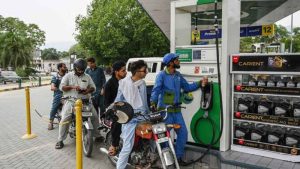
The announcement triggered a rush at petrol pumps across several cities as motorists hurried to fill their tanks before the new prices took effect at midnight.
Long queues formed at fuel stations, while reports from multiple areas indicated that some pumps temporarily stopped selling fuel, apparently to avoid dispensing stocks at the previous rates.
Authorities warned that strict action would be taken against hoarding or attempts to create artificial shortages.
Impact of regional conflict
Speaking at the briefing, Malik said the surge in prices was driven by volatility in global energy markets following the conflict in the Middle East.
“The fire that started in a neighbouring country has spread across the entire region,” he said, adding that it was unclear how long the crisis would last.
Pakistan relies heavily on oil shipments passing through the strategic Strait of Hormuz, a critical global energy route that has been affected by the ongoing tensions.
However, the minister said two vessels operated by the Pakistan National Shipping Corporation were currently travelling through alternative routes via Yanbu in Saudi Arabia and Fujairah in the United Arab Emirates to ensure continued fuel supplies.
Global oil prices jump
International oil markets have reacted sharply to the conflict.
According to global market data, US crude futures climbed more than 12% to above $90 per barrel, while Brent crude rose roughly 8% to around $92 per barrel, approaching the key $100 threshold that often signals market stress.
Officials said the government would now review petroleum prices on a weekly basis to respond more quickly to global market fluctuations.
“As soon as the international situation improves, we will reduce prices at the same pace,” Malik said.
Fuel conservation plan delayed
Earlier in the day, the government decided to defer a proposed national fuel conservation plan that included work-from-home arrangements and distance learning for educational institutions.
The decision was taken during a high-level meeting on petroleum reserves chaired by Prime Minister Shehbaz Sharif.
Sources said the plan had been prepared by a cabinet committee and discussed with provincial authorities, but it was decided to postpone its implementation for at least a week as current reserves were considered sufficient.
The contingency measures had also been discussed with the International Monetary Fund.
According to a statement from the Prime Minister’s Office Pakistan, officials were informed during the meeting that the country’s fuel stocks were adequate to meet national demand for the time being.
The prime minister directed authorities to establish a real-time monitoring dashboard to track the movement and transportation of petroleum products across the country.
Crackdown on hoarding
Meanwhile, the government of Punjab ordered district administrations to launch an immediate crackdown on hoarding of petroleum products.
The directive was issued during a meeting chaired by Chief Secretary Zahid Akhtar Zaman at the Civil Secretariat.
Deputy commissioners across the province were instructed to take strict legal action against individuals or businesses involved in illegal storage or manipulation of fuel supplies.
Authorities warned that petrol pumps found creating artificial shortages could face sealing of premises, cancellation of licences and legal proceedings.
Officials said the government would continue monitoring global developments closely, as the evolving regional conflict continues to pose risks to energy markets and domestic fuel prices.
About Author