Inflation dampens Ramazan traditions as iftar gatherings decline in Rawalpindi
By Sadia khan :
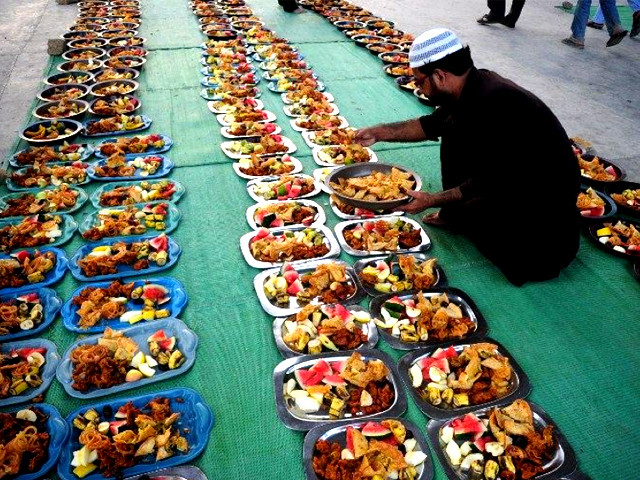
Rising inflation and declining purchasing power have significantly reduced political and social iftar gatherings in Rawalpindi during Ramazan this year, marking a noticeable shift in a long-standing cultural and political tradition in the city.
For decades, Ramazan in Rawalpindi has been associated with large-scale social and political iftar and sehri gatherings. Political leaders, social organisations, traders, and philanthropists regularly hosted daily meals throughout the holy month, often organising what was popularly known as “30 iftars and 30 sehris.”
However, this year the tradition has largely disappeared as soaring food prices and economic pressures have made such events increasingly difficult to organise.
Residents say the cost of food items commonly used in sehri and iftar has risen so sharply that many families are struggling to manage their own meals, leaving little room for large-scale community gatherings.
As a result, the number of political and social iftar events across the city has declined sharply.
Government-funded iftar gatherings have also been suspended due to the country’s ongoing financial crisis, effectively ending official Ramazan social events that were once organised by various public institutions.
With fewer organised events available, many low-income individuals who observe the fast are now relying on mosques and imambargahs to break their fast.
Volunteers and religious institutions across the city have reported an increase in the number of people attending community iftars, particularly labourers, daily wage earners and travellers who cannot afford full meals.
Meanwhile, government-run Ramazan relief markets have been providing basic iftar arrangements, but citizens say these are often limited to dates, water and a few small food items.
Many people who attend these arrangements say the meals are only sufficient to break the fast and do not fully satisfy hunger.
End of a long political tradition
One of the most notable Ramazan traditions in Rawalpindi was organised by veteran politician Sheikh Rasheed Ahmed, the chief of the Awami Muslim League and a former interior minister of Pakistan.
For decades, Sheikh Rasheed hosted daily iftar and sehri programmes throughout Ramazan, inviting political workers, journalists, labourers and members of the public.
The initiative became widely known as the “30 iftars and 30 sehris” programme and attracted large crowds every year.
However, the number of such events began to decline last year due to rising costs, and this year the programme has almost come to an end.
Only a few symbolic iftar gatherings have been organised so far, while no political sehri event has been held during the first 15 days of Ramazan.
Observers say the disappearance of such large-scale gatherings reflects the deep economic challenges currently facing the country.
Reduced political activity
Political activity during Ramazan has also declined across the city.
During the past two weeks, only a handful of discreet political iftar gatherings have taken place in Rawalpindi, and those events featured significantly reduced menus.
Instead of the elaborate spreads traditionally served at such gatherings, the menus have been limited to simple items such as chicken pakoras, naan and dates.
None of the major political parties including the Pakistan Peoples Party, Pakistan Muslim League-N, Pakistan Muslim League-Q, Pakistan Tehreek-e-Insaf and Tehreek-e-Labbaik Pakistan have yet organised a large-scale iftar gathering for party workers in the city or cantonment areas.
According to political workers, only three political iftar events have been held in Rawalpindi and nearby cantonment areas during the first half of Ramazan.
Even those events had limited attendance, with many local workers and party supporters not invited.
Long-time political workers say the change is unprecedented.
Maqbool Khan and Chaudhry Ikram, who have been active in local politics for years, said that in previous Ramazans party workers would attend iftar or sehri gatherings almost every day.
“This year, during the first two weeks of Ramazan, only one gathering was organised for workers,” they said.
Plans for limited gatherings
Despite the slowdown, some political parties say they are still planning to hold iftar gatherings later in the month.
Mian Khurram Rasool, city president of the Pakistan Peoples Party, said the party would soon organise a large iftar event for its workers after consultation with senior leadership.
Similarly, Sardar Naseem Khan, city president of the Pakistan Muslim League-N and a former mayor of Rawalpindi, said the party planned to arrange iftar gatherings between the 20th and 28th of Ramazan.
However, political observers believe these events are likely to remain modest compared with those held in previous years.
Catering industry affected
The sharp decline in iftar and sehri gatherings has also affected the local catering and hospitality industry.
Shaukat Ali, vice-president of the Food Catering Association, said the number of orders for Ramazan events has dropped dramatically this year.
“In previous years we used to be extremely busy, and all bookings were completed even before Ramazan started,” he said.
“This year we have received very few orders.”
He attributed the decline mainly to inflation and political uncertainty.
Farooq Chaudhry, president of the Hotels and Restaurants Association, confirmed that sehri events had almost disappeared this year, while iftar gatherings had reduced significantly.
According to restaurant owners, the rising cost of food ingredients, fuel and electricity has made it difficult to organise large gatherings at affordable rates.
Rising prices add to hardship
Meanwhile, the surge in food prices during Ramazan has further added to public hardship in Rawalpindi.
Despite measures introduced by authorities to control prices, vendors in the city’s open markets have begun charging what residents describe as arbitrary rates for essential food items.
With the exception of potatoes, almost all essential commodities have become more expensive as Ramazan enters its 17th day.
At present, beef with bone is being sold for around Rs1,400 per kilogram, while boneless beef has reached Rs1,600 per kilogram.
Mutton prices have climbed to Rs2,600 per kilogram, while chicken meat is being sold for around Rs600 per kilogram.
Other items commonly consumed during Ramazan have also seen significant increases.
A dozen cleaned goat trotters are being sold for about Rs2,600, while four cleaned beef trotters are priced at approximately Rs4,200.
Butchers and poultry vendors have largely set their own prices, with traders warning that further increases may occur as Eid approaches.
The fruit market has witnessed a similar trend.
Apples are currently being sold for around Rs550 per kilogram, bananas for Rs280 per dozen, guavas for Rs250 per kilogram, and kinnow for Rs350 per dozen.
In the vegetable market, potatoes remain the only relatively affordable item, selling at around Rs120 for five kilograms.
Prices of most other vegetables have increased during Ramazan.
Citizens call for action
Many residents have urged authorities to take stronger measures to control the prices of essential food items.
Citizens say that without effective intervention, completing the remaining days of Ramazan will become increasingly difficult for many households.
With Eidul Fitr approaching, concerns are also growing about the possibility of another wave of inflation.
A significant increase in petroleum prices is expected ahead of Eid, which could push transport and food costs even higher.
Vendors defend price increases
Vendors, however, argue that they are not responsible for the rising prices.
Traders dealing in meat, poultry, fruits and vegetables say they are forced to sell goods according to the rates at which they purchase them from wholesalers.
They say transportation expenses, electricity costs and other operational charges have also increased significantly.
According to vendors, they add only a reasonable profit margin after accounting for these expenses.
Many traders warn that the recent increase in petroleum prices is likely to further intensify inflationary pressure in the coming days.
Ineffective price control measures
Earlier this year, the Government of Punjab introduced strict price-control measures to prevent excessive increases in food prices during Ramazan.
However, residents and market observers say the measures have so far failed to produce meaningful results.
Seven days of the second Ashra of Ramazan have already passed, yet the prices of most essential items continue to rise.
For many families in Rawalpindi, the economic pressure has transformed the spirit of Ramazan this year.
Instead of the traditional atmosphere of large communal gatherings and generous hospitality, many residents are focusing on managing basic household expenses and finding simple ways to break their fast.
As inflation continues to climb, the city’s once vibrant Ramazan traditions appear to be fading under the weight of economic hardship.
About Author