Total Lunar Eclipse to Cast ‘Blood Moon’ Glow on Tuesday Afternoon
By Tanveer Ahmed :
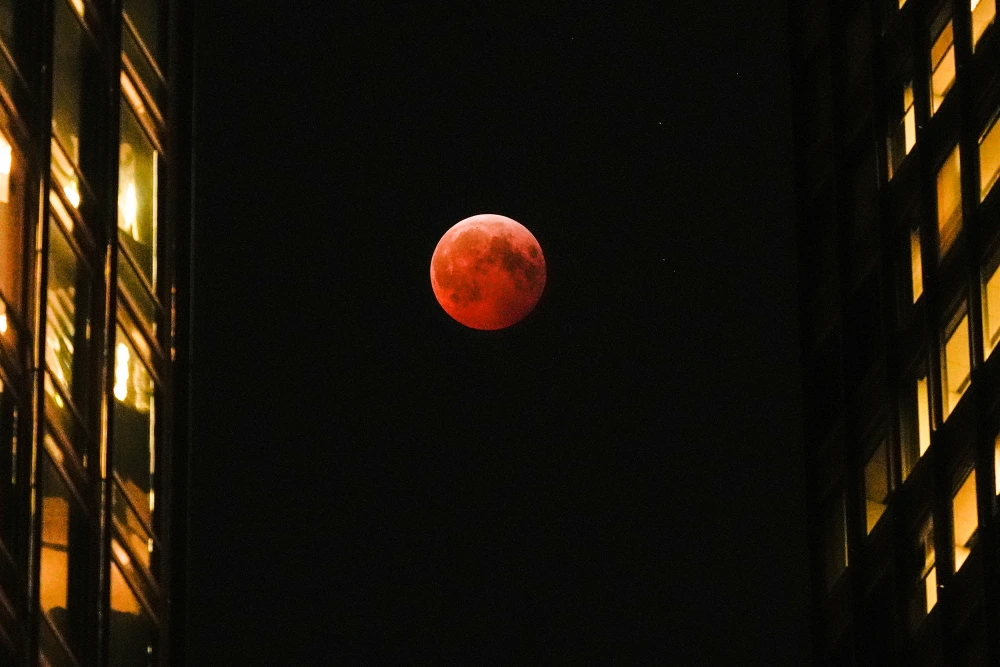
A total lunar eclipse is set to take place on Tuesday afternoon, transforming the full Moon into a striking reddish-orange hue as the Earth passes directly between the Sun and the Moon.
The phenomenon occurs during a full Moon when the Earth aligns precisely between the Sun and its natural satellite, causing Earth’s shadow to fall across the Moon’s surface.
As sunlight travels through Earth’s atmosphere, shorter blue wavelengths are scattered, while red and orange light continues onward and bends towards the Moon. This filtering effect gives the eclipsed Moon its distinctive coppery-red appearance — often referred to as a “Blood Moon”.
Timings in Pakistan
According to the Pakistan Meteorological Department (PMD), the eclipse will begin with the penumbral phase at 1:44pm Pakistan time, when the Moon enters the Earth’s outer shadow and gradually starts to dim.
The partial phase will follow at 2:50pm, with totality beginning at 4:05pm. The eclipse will reach its maximum at 4:34pm. Totality will start to end at 5:03pm, and the event will conclude completely at 7:23pm.
However, much of the eclipse will unfold during daylight hours in Pakistan, meaning it may not be clearly visible in most parts of the country. Observers could still catch the later stages in the evening, depending on local moonrise times and weather conditions. The PMD said the eclipse would be partially visible from some cities.
Global Visibility
Internationally, the full eclipse will be visible in the evening across eastern Asia and Australia. It will appear overnight throughout the Pacific region and before sunrise in parts of North and Central America, as well as the western edge of South America.
Observers in central Asia and much of South America will witness only a partial eclipse, while the event will not be visible from Africa or Europe.
How to Watch
Unlike solar eclipses, lunar eclipses can be viewed safely with the naked eye. Experts say no special protective equipment is required, provided the Moon is visible in the sky.
For a clearer and more detailed view, observers are advised to watch from areas with minimal light pollution. Using binoculars or a telescope can further enhance the experience.
About Author