Armed forces remain prepared amid evolving regional security challenges : ISPR
By Sadia Khan :
The Pakistan military has said the country remains fully prepared to respond to future security threats, with senior officials highlighting what they described as the growing role of indigenous military capabilities and multi-domain warfare preparedness.
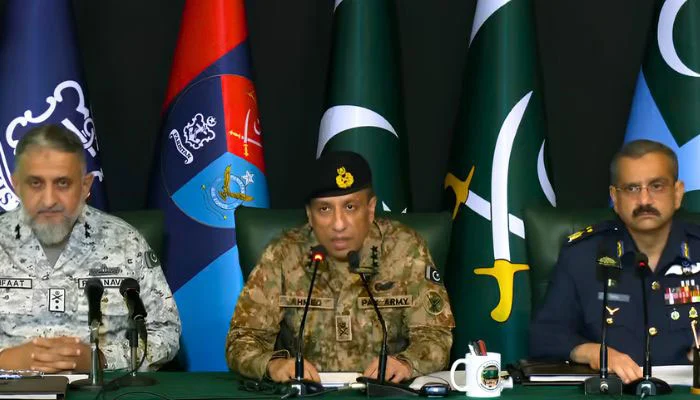
Addressing a lengthy press conference in Islamabad on Thursday, Lt Gen Ahmed Sharif Chaudhry said Pakistan’s armed forces had strengthened their operational readiness following last year’s military confrontation with India, which Pakistani authorities refer to as “Marka-i-Haq”.
The briefing, held on the first anniversary of the conflict, was also attended by Rear Admiral Shifaat Ali and Air Vice Marshal Tariq Ghazi.
The military confrontation began after the April 2025 attack in Pahalgam and escalated into cross-border military exchanges before ending with a ceasefire on May 10 following Pakistan’s Operation Bunyanum Marsoos.
During the briefing, the ISPR chief said Pakistan’s armed forces had successfully met national expectations despite facing what he described as a numerically larger adversary.
“We were prepared then, and we are prepared today as well,” he said while discussing the changing nature of modern warfare, which he described as extending beyond conventional battlefields into cyberspace, information operations and cognitive domains.
Lt Gen Chaudhry outlined what he termed the “strategic consequences” of the conflict, arguing that the crisis had reshaped regional security perceptions and demonstrated Pakistan’s ability to respond across multiple operational fronts.
He also criticised India’s political and military leadership, accusing New Delhi of politicising military institutions and pursuing aggressive rhetoric. Indian officials have consistently rejected Pakistan’s allegations and maintain that Islamabad supports militancy in the region, a claim Pakistan denies.
The military spokesperson further reiterated Pakistan’s longstanding position on Kashmir, describing it as an internationally recognised dispute that should be resolved in accordance with United Nations resolutions and the wishes of the Kashmiri people.
During the briefing, military officials also discussed counterterrorism operations and regional security concerns linked to Afghanistan.
Lt Gen Chaudhry alleged that militant groups operating inside Pakistan were receiving support from India while using Afghan territory as a base. Kabul and New Delhi have previously denied similar allegations made by Pakistani officials.
The ISPR chief said Pakistan’s Operation Ghazab lil-Haq remained ongoing and formed part of the country’s broader national strategy against militancy.
The press conference also placed heavy emphasis on Pakistan’s domestically developed military technologies and defence modernisation efforts.
Video presentations shown during the event highlighted a range of locally developed capabilities, including surface-to-air missile systems, cruise missiles, drones, anti-drone systems, loitering munitions, artillery systems and military satellites.
Lt Gen Chaudhry described the showcased equipment as “homegrown” and said Pakistan’s operational preparedness was backed by both technological progress and public support.
Rear Admiral Shifaat Ali said the Pakistan Navy had successfully safeguarded maritime trade routes during the conflict and maintained operational control in the Arabian Sea.
He stated that Indian naval forces had attempted to increase their presence in the northern Arabian Sea during the crisis but claimed Pakistan’s naval strategy prevented any disruption to ports or shipping activity.
The naval official also said Pakistan had maintained surveillance over Indian naval movements and was prepared for escalation if required.
Meanwhile, Air Vice Marshal Tariq Ghazi detailed the Pakistan Air Force’s operational response during the confrontation.
He claimed the PAF successfully defended Pakistani airspace and later shifted to offensive operations after Indian attacks. According to the air force official, Pakistan targeted multiple Indian military assets during the conflict.
India has not publicly confirmed several of the claims made by Pakistani officials regarding aircraft losses and damage to military infrastructure.
The PAF official also highlighted future modernisation efforts, revealing that more than 160 development projects were currently under way to strengthen Pakistan’s air capabilities.
Responding to questions from journalists, Lt Gen Chaudhry said Pakistan did not seek conflict but would defend itself if challenged.
He warned that any future military escalation between two nuclear-armed neighbours would carry serious consequences, stressing the importance of deterrence and strategic stability in South Asia.
The ISPR chief also reiterated Pakistan’s close security ties with Saudi Arabia, stating that threats to Saudi security were viewed as threats to Pakistan as well.
On domestic political matters, Lt Gen Chaudhry said political disputes should be resolved through dialogue among political parties and maintained that the military was not a stakeholder in Pakistan’s internal politics.
The press conference came amid continuing tensions in the region and heightened international attention on South Asian security dynamics following last year’s military escalation between Pakistan and India.
About Author