
Artemis II Crew Set to Make History on First Human Moon Mission in Over 50 Years
By Tanver ahmed :
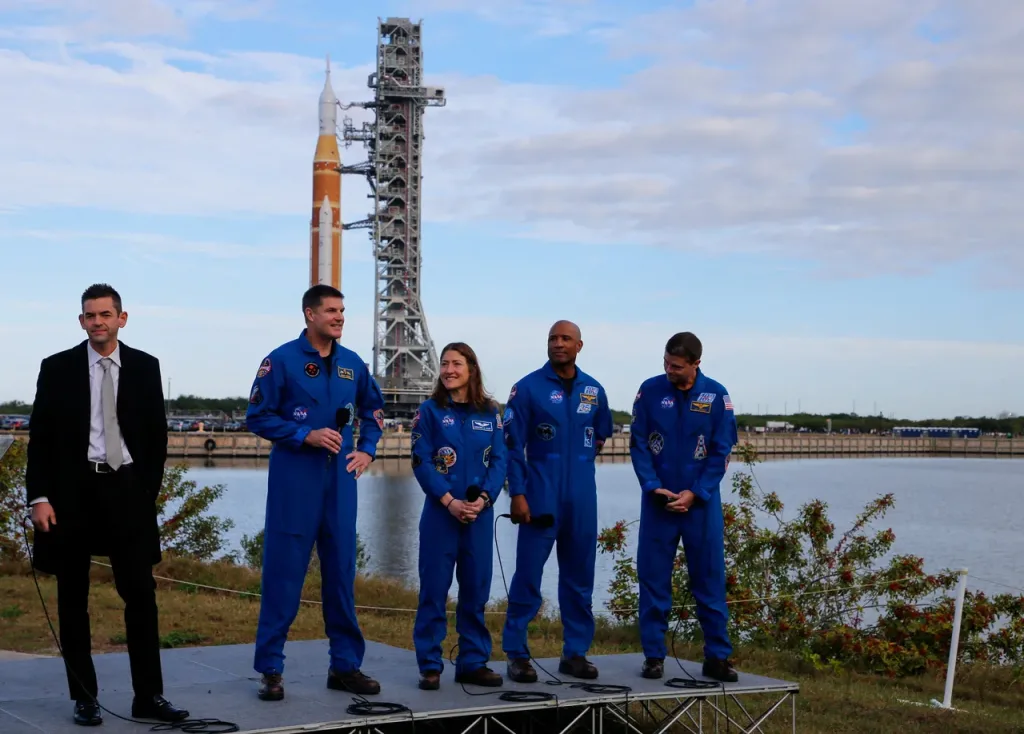
NASA’s Artemis II mission, scheduled to launch as soon as April, will send four astronauts on the first human journey around the Moon in more than five decades, marking a major milestone in modern space exploration.
The crew represents a historic shift in the makeup of deep-space explorers. For the first time, a woman, a Black astronaut and a Canadian astronaut will travel on a mission to the vicinity of the Moon expanding beyond the Apollo-era astronaut corps, which consisted entirely of White American men, most with military backgrounds.
Despite this new diversity, the astronauts share strong technical credentials similar to their Apollo predecessors, including test pilot experience, engineering expertise and previous spaceflight training.
A Historic Crew
The Artemis II team includes NASA astronauts Reid Wiseman, Victor Glover and Christina Koch, along with Canadian Space Agency astronaut Jeremy Hansen.
- Reid Wiseman, a former US Navy test pilot, will serve as mission commander.
- Victor Glover, also a naval test pilot, will become the first Black astronaut to travel into deep space.
- Christina Koch, an electrical engineer and record-holding astronaut, will be the first woman to venture toward the Moon.
- Jeremy Hansen, a Royal Canadian Air Force fighter pilot, will be the first non-NASA astronaut assigned to a lunar mission.
The mission will send the crew on a 10-day journey covering roughly 600,000 miles (965,000 kilometres) as the spacecraft loops around the Moon before returning to Earth.
Risks of Deep-Space Travel
Artemis II will push astronauts farther into space than any humans have travelled before, beyond the Moon’s far side.
The mission involves several risks, including exposure to higher radiation levels and periods when communication with mission control may be lost because of the spacecraft’s distance from Earth.
The crew will also be the first humans to fly aboard NASA’s Orion spacecraft and the Space Launch System (SLS) rocket, hardware developed over two decades at a cost exceeding $40 billion.
Astronaut Jeremy Hansen acknowledged the dangers during training, saying mission preparations include discussions about emergency scenarios in case communications or spacecraft systems fail.
A Step Toward Returning to the Moon
Artemis II will not land on the lunar surface but will act as a test flight for future missions.
NASA plans to follow the mission with Artemis III, which aims to land astronauts near the Moon’s south pole, an area scientists believe may contain significant ice deposits.
The Artemis programme is designed as a foundation for long-term human presence on the Moon and as preparation for future missions to Mars.
Victor Glover said the mission represents a major step forward in human exploration.
“We need to celebrate this moment in human history,” he said after being selected for the mission. “It is the next step in the journey that will get humanity to Mars.”
About Author