
Dutch Students Unveil Solar-Powered Off-Road Ambulance for Remote Communities
ES Mag :
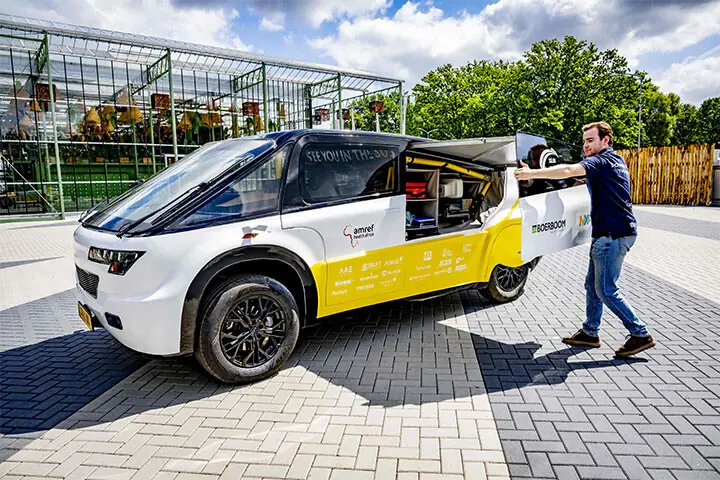
A team of Dutch university students has unveiled what they believe to be the world’s first solar-powered ambulance, designed to deliver essential medical care to some of the most isolated regions on Earth.
The sleek, white and yellow two-seater vehicle—dubbed the Stella Juva—was created by a student team from the Eindhoven University of Technology. Built specifically to tackle rugged, off-road terrain, the vehicle can reach top speeds of 120 km/h (75 mph) while drawing energy directly from roof-mounted solar panels.
Unlike traditional ambulances designed primarily for rapid patient transport to hospitals, the Stella Juva is built as a mobile clinic intended to bring diagnostic care and treatment directly to the patient’s doorstep.
A Mobile Clinic Off the Grid
The vehicle’s solar arrays do far more than power its electric drivetrain. They are integrated into an onboard electrical system designed to run complex, life-saving medical equipment completely off the grid.
Equipment integrated into the vehicle includes:
- Diagnostic Tools: Onboard digital X-ray machines, pregnancy ultrasound scanners, and rapid testing kits for infectious diseases such as tuberculosis.
- Emergency & Preventive Care: Automated external defibrillators and temperature-controlled refrigeration units to safely store heat-sensitive vaccines.
- All-Weather Capability: A high-capacity solar-charged battery system that ensures both the vehicle and its full suite of medical instruments remain fully operational during nighttime transit or prolonged overcast weather.
On a sunny day, the Stella Juva boasts an operational range of up to 715 kilometres (444 miles), allowing it to complete lengthy round trips through vast, unpaved rural areas without relying on local fuel or electrical infrastructure.
Real-World Field Testing in East Africa
The innovation addresses severe healthcare accessibility gaps faced by millions of people living in geographically isolated regions. Development partners note that in many developing nations, the sheer distance between remote villages and centralized medical centers remains one of the largest hurdles to basic healthcare delivery and early disease diagnosis.
To test the design under demanding real-world conditions, the student engineering team plans to travel to Kenya next month. The deployment will allow engineers and health workers to evaluate how the vehicle’s suspension, solar efficiency, and diagnostic gear handle extreme heat, dusty environments, and unpaved terrain.
About Author