Iran Rejects Talks With US as Conflict Widens Across Middle East
By Tahir Shah :
Iran has ruled out negotiations with the United States and signalled it is prepared to sustain the conflict for as long as necessary, senior officials have said, as fighting spreads across the Middle East.
Mohammad Mokhber, an aide to the late Supreme Leader Ali Khamenei, told state television that Tehran had “no trust in the Americans” and saw no basis for dialogue.
“We can continue the war as long as we want,” he said.
His remarks were echoed by Iran’s security chief Ali Larijani, who dismissed reports that Tehran was seeking to revive negotiations with Washington.
Air Strikes and Missile Barrages
The conflict, now in its fifth day, was triggered by joint US and Israeli strikes on Iran. The Israeli military said one of its F-35I “Adir” jets had shot down an Iranian YAK-130 fighter aircraft over Tehran, as part of what it described as a broader wave of strikes targeting command centres and security facilities, including sites linked to the Basij paramilitary force.
Iran’s Islamic Revolutionary Guard Corps said it had launched more than 40 missiles in a fresh barrage against US and Israeli targets. It also claimed to have “complete control” of the Strait of Hormuz, a strategic waterway through which roughly one-fifth of global seaborne oil passes, warning that vessels attempting to cross could be at risk.
US President Donald Trump said the US Navy stood ready to escort oil tankers through the Gulf route and claimed American forces had severely degraded Iran’s naval and air capabilities.
Admiral Brad Cooper, head of US Central Command, said nearly 2,000 targets had been struck since operations began, describing the scale of the assault as the largest American military build-up in the region in a generation.
Lebanon Drawn Further In
The violence has increasingly affected neighbouring Lebanon, where the Iran-backed group Hezbollah has exchanged fire with Israel.
The Israeli military issued evacuation warnings to residents in 16 towns and villages in southern Lebanon before launching what it called “broad-scale strikes” on Hezbollah positions.
Lebanese state media reported that Israeli air strikes hit a residential building in Baalbek and a hotel in Beirut’s eastern suburb of Hazmieh. The health ministry said at least 52 people have been killed in Lebanon since hostilities began, with more than 30,000 displaced, according to the United Nations.
Israel said it was moving troops across the border to establish a buffer zone inside Lebanon, in a move reminiscent of earlier conflicts between the two countries.
Regional and Global Impact
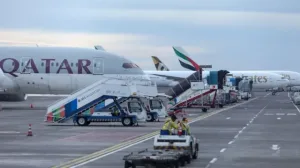
Across the Gulf, governments have scrambled to evacuate stranded citizens as airspace disruptions continue. Qatar said it intercepted missiles targeting Hamad International Airport in Doha, while Oman and the United Arab Emirates reported drone activity affecting ports and energy facilities.
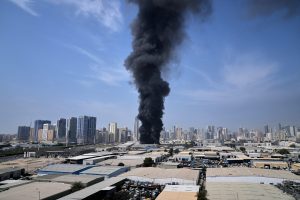
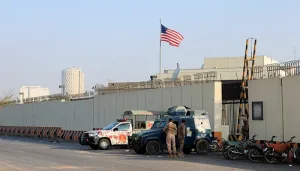
In Dubai, drones struck near the US consulate, causing a fire but no casualties. Similar attacks were reported against US diplomatic and military sites in Riyadh, Kuwait City and Bahrain.
The US State Department has ordered the departure of non-emergency personnel from several missions in the region and urged American citizens to leave if commercial flights are available. Officials say around 9,000 US nationals have already departed.
Mounting Casualties
Iran’s Red Crescent says 787 people have been killed in the country since the start of the conflict, though the figure has not been independently verified. Iranian media reported heavy casualties in several cities, including Minab and Qom.
The US military has begun naming six service members killed in the fighting. In Israel, nine people were killed when a missile struck the town of Beit Shemesh. At least eight others have died across Gulf states.
Despite calls from some Western leaders for de-escalation, the rhetoric from Tehran and Washington remains uncompromising. President Trump said that although he believed Iran had sought renewed talks, it was now “too late”.
While both Washington and Israeli Prime Minister Benjamin Netanyahu have urged Iranians to challenge their leadership, Mr Trump said regime change was not the stated objective of the campaign.
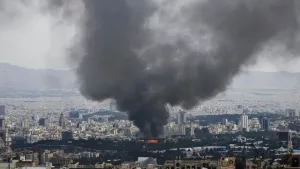
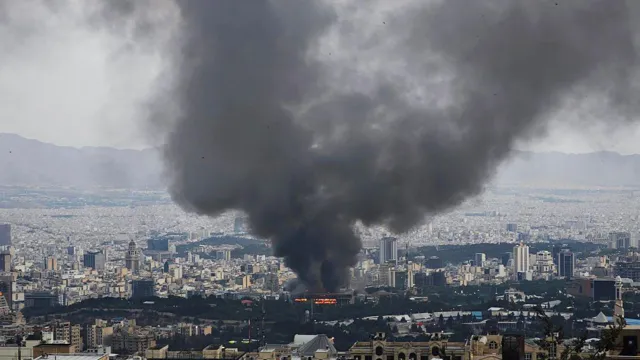
For residents of Tehran, the atmosphere is tense. Streets in parts of the capital, normally home to about 10 million people, have fallen quiet as many flee and security forces increase patrols.
With neither side signalling a willingness to step back, fears are growing that the conflict could further destabilise an already volatile region.
About Author