Shehbaz Sharif Seeks Expanded Chinese Investment as Pakistan Pushes Ahead With CPEC Phase II
By Sadia Khan :
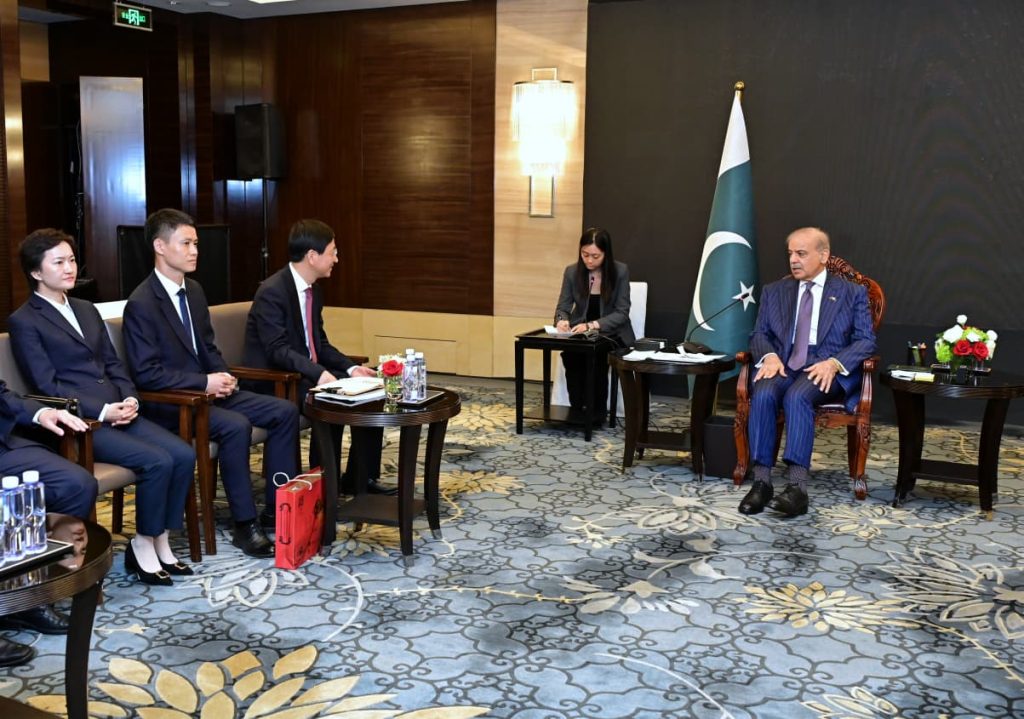
Prime Minister Shehbaz Sharif held a series of meetings with senior executives from leading Chinese companies during his official visit to China, as Pakistan sought to attract fresh investment and accelerate major infrastructure and industrial projects under the second phase of the China-Pakistan Economic Corridor.
The meetings took place during the prime minister’s four-day visit aimed at strengthening economic cooperation between Islamabad and Beijing at a time when Pakistan is attempting to stabilise its economy, expand industrial output and modernise infrastructure through foreign investment.
Officials said the discussions focused on agriculture, manufacturing, logistics, transport connectivity, mineral development and technology transfer, with the Pakistani side emphasizing the government’s commitment to creating a more investment-friendly environment for Chinese businesses.
During one of the meetings, Shehbaz Sharif met executives from FAMSUN led by chief executive Zhengjun Chen and praised the company’s role in supporting Pakistan’s agriculture sector.
The prime minister highlighted Pakistan’s efforts to reduce post-harvest crop losses and improve food security, two longstanding challenges facing the country’s agricultural economy. He encouraged the company to establish manufacturing facilities and transfer technology to Pakistan, particularly through investment opportunities available in Special Economic Zones under CPEC and the government’s Green Pakistan Initiative.
Agriculture remains one of Pakistan’s largest economic sectors, employing a significant portion of the workforce, but the country continues to face major inefficiencies in storage, transportation and food processing infrastructure. Officials believe Chinese technology and investment could help modernise the sector and reduce wastage.
Shehbaz Sharif also met a delegation from Shandong Xinxu Group Corporation headed by chairman Hou Jianxin.
According to officials, discussions focused on the company’s expanding interests in Pakistan, including maritime development, battery manufacturing, mineral processing and industrial cooperation projects.
The prime minister welcomed progress on the proposed Xinxu Special Economic Zone and the Sea-to-Steel project planned at Port Qasim. He also reiterated government support for Chinese investments linked to Gwadar and mineral-rich northern regions of Pakistan, which authorities hope will play an increasingly important role during CPEC’s second phase.
Pakistan is attempting to shift the focus of CPEC from energy and transport projects towards industrialisation, export-oriented manufacturing and technology partnerships after completing several large infrastructure schemes during the corridor’s first phase.
In another meeting, the prime minister met senior officials from China Communications Construction Corporation and representatives of China Road and Bridge Corporation.
Shehbaz Sharif praised the companies for their decades-long role in Pakistan’s infrastructure development, including major transport and connectivity projects such as the Karakoram Highway and the Rashakai Special Economic Zone.
The prime minister reiterated Islamabad’s commitment to fast-tracking strategic projects under CPEC Phase II, including the long-delayed Main Line-1 railway project and the realignment and expansion of the Karakoram Highway.
Officials say the ML-1 railway modernisation project is considered one of the most significant components of Pakistan’s transport infrastructure plans, aimed at upgrading the country’s rail network, increasing train speeds and improving regional trade connectivity.
The Chinese companies reportedly expressed confidence in Pakistan’s economic potential and showed interest in expanding investment across several sectors, including logistics, industrial manufacturing, infrastructure development and technology.
The meetings come as Pakistan seeks stronger economic engagement with China amid ongoing financial pressures and efforts to attract long-term foreign investment. Beijing remains Islamabad’s largest strategic and economic partner, with CPEC continuing to form a central pillar of bilateral relations between the two countries.
Senior Pakistani ministers and government officials accompanying the prime minister were directed to ensure timely follow-up on decisions and agreements discussed during the meetings, according to officials familiar with the visit.
About Author