
Scientists detect possible atmosphere on distant Kuiper Belt object beyond Pluto
By Tanveer Ahmed :
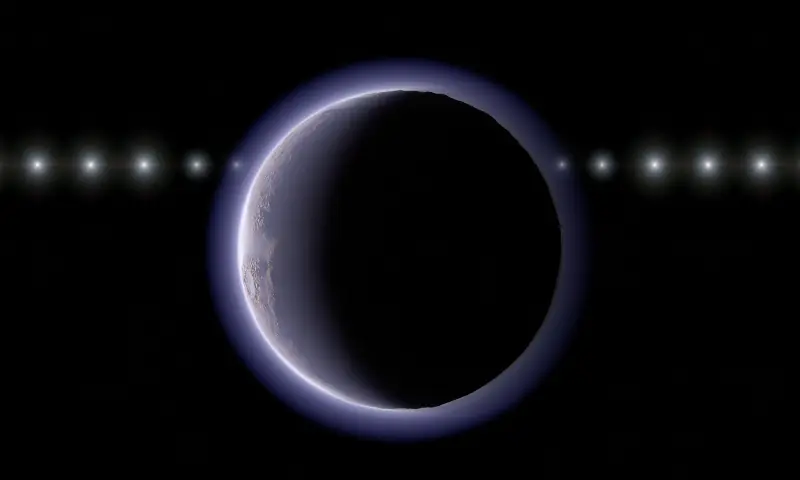
Astronomers in Japan say they may have identified an atmosphere around a small icy world far beyond Pluto, a finding that could challenge long-held assumptions about the outer reaches of the Solar System.
The object, known as (612533) 2002 XV93, lies in the distant Kuiper Belt, roughly six billion kilometres from Earth. Measuring about 500 kilometres across, it was previously thought too small and cold to sustain any form of atmosphere.
If confirmed, it would become only the second known object beyond Neptune with an atmosphere, after Pluto.
The discovery was made when researchers observed the object passing in front of a distant star in early 2024. Instead of the starlight reappearing abruptly, it faded and returned gradually, suggesting that a thin layer of gas may have filtered the light a key indicator of an atmosphere.
According to findings published in Nature Astronomy, the suspected atmosphere is extremely tenuous, estimated to be millions of times thinner than Earth’s. Despite its faintness, its presence would challenge existing theories that small icy bodies in the outer Solar System are largely inactive and incapable of retaining gases.
Lead researcher Ko Arimatsu said the observation could reshape scientific understanding of these distant worlds, which have traditionally been viewed as frozen remnants with little geological or atmospheric activity.
Scientists are still uncertain about the origin of the possible atmosphere. One theory suggests it could be produced by cryovolcanism eruptions of volatile materials such as ice and gas from beneath the surface. Another possibility is that it was generated by a recent collision with a comet, meaning it could dissipate over time.
However, some researchers remain cautious. Alternative explanations, including the presence of a ring system around the object, have not been fully ruled out. Experts say further observations will be needed to confirm the findings and better understand the phenomenon.
Future studies, potentially involving the James Webb Space Telescope, could provide more detailed data on the object’s composition and behaviour.
The discovery comes amid renewed debate over Pluto’s status, which was downgraded from a planet to a dwarf planet in 2006. Some policymakers in the United States have recently floated the idea of restoring its classification, but scientists say findings like this highlight the complexity and diversity of objects in the outer Solar System.
For now, researchers say the possible detection of an atmosphere on such a small and distant world opens a new chapter in the study of planetary science, suggesting that even the most remote corners of the Solar System may be more dynamic than previously believed.
About Author