
Middle East Airspace Closures Trigger Widespread Flight Disruptions Worldwide
By Sardar Burhan :
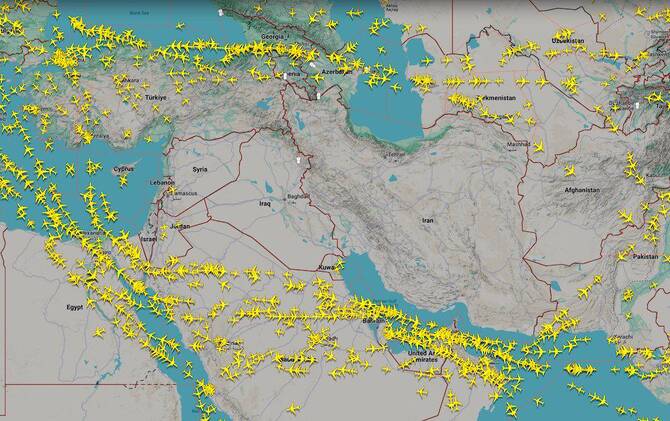
Airlines across the globe have suspended services to parts of the Middle East, causing the most significant disruption to international air travel since the Covid-19 pandemic.
The cancellations follow US and Israeli strikes on Iran and subsequent missile launches by Tehran targeting cities across the Gulf region. In response, several countries moved to close or restrict their airspace, leaving thousands of passengers stranded and forcing airlines to reroute or suspend operations.
Thousands of Flights Affected
According to aviation analytics firm Cirium, nearly 23% of the 4,218 flights scheduled to land in Middle Eastern countries on Saturday were cancelled — a total of 966 services. When outbound flights are included, cancellations exceeded 1,800.
For Sunday, 716 of the 4,329 planned arrivals to the region were called off, the company said.
Flight tracking platform FlightAware reported that more than 19,000 flights had been delayed worldwide by early Sunday, with over 2,600 cancelled.
Countries Close Their Skies
Several governments announced partial or full airspace closures as the situation escalated.
Iran suspended flights “until further notice,” according to its Civil Aviation Organization. Israel also closed its airspace to civilian traffic, Transport Minister Miri Regev confirmed.
Airspace restrictions were also introduced in Qatar, Iraq, Kuwait, Syria and the United Arab Emirates, with some countries describing the measures as temporary and precautionary. Jordan said its air force was conducting drills to safeguard its airspace.
Gulf and Regional Airlines Suspend Services
Major Middle Eastern carriers scaled back operations significantly.
Dubai-based Emirates and Abu Dhabi’s Etihad Airways cancelled 38% and 30% of their flights respectively, according to Cirium.
Qatar Airways suspended all departures from Doha, accounting for 41% of its scheduled services. Syria’s national carrier halted operations entirely.
Egypt’s state-owned EgyptAir suspended flights to several regional destinations, including Dubai, Doha, Manama, Abu Dhabi, Beirut and Baghdad.
European Airlines Halt Routes
Russia’s aviation authority Rosaviatsia announced a suspension of commercial flights to Israel and Iran.
Among European carriers, Turkish Airlines cancelled services to multiple destinations including Lebanon, Syria, Iraq and Iran.
Air France suspended flights to Dubai, Riyadh and Beirut, while British Airways paused services to Tel Aviv and Bahrain.
Germany’s Lufthansa — which includes Swiss and ITA Airways — halted flights to several Middle Eastern cities and temporarily suspended services to Dubai and Abu Dhabi.
North American and Asia-Pacific Impact
In North America, Delta Air Lines suspended flights between New York and Tel Aviv. American Airlines paused its Doha–Philadelphia service, while United Airlines cancelled flights to Tel Aviv and Dubai.
Air Canada also halted services to Israel and the UAE for several days.
Across Asia-Pacific, Air India and IndiGo suspended all Middle East routes.
Pakistan’s national carrier, Pakistan International Airlines, paused flights to destinations including the UAE, Bahrain, Doha and Kuwait.
Hong Kong’s Cathay Pacific and Indonesia’s Garuda Indonesia also suspended selected regional services. Singapore Airlines and its subsidiary Scoot cancelled multiple routes, while Philippine Airlines grounded several Middle East-bound flights.
Meanwhile, Australia’s Qantas and Japan’s All Nippon Airways did not immediately announce cancellations.
African Carriers Adjust Operations
Africa’s largest airline, Ethiopian Airlines, cancelled services to several Middle Eastern cities, while Kenya Airways suspended flights to Dubai and Sharjah.
Ongoing Uncertainty
Aviation analysts say the scale of disruption highlights the fragility of global air networks during geopolitical crises. With multiple air corridors closed and security concerns mounting, further cancellations and delays are possible if tensions persist.
For passengers, airlines are advising travellers to check flight statuses regularly as the situation continues to evolve.
About Author