
UN Human Rights Council to Debate Taliban’s New Penal Code, Described as Turning Afghanistan into ‘Graveyard of Human Rights’
By Zeeshan Naseem :
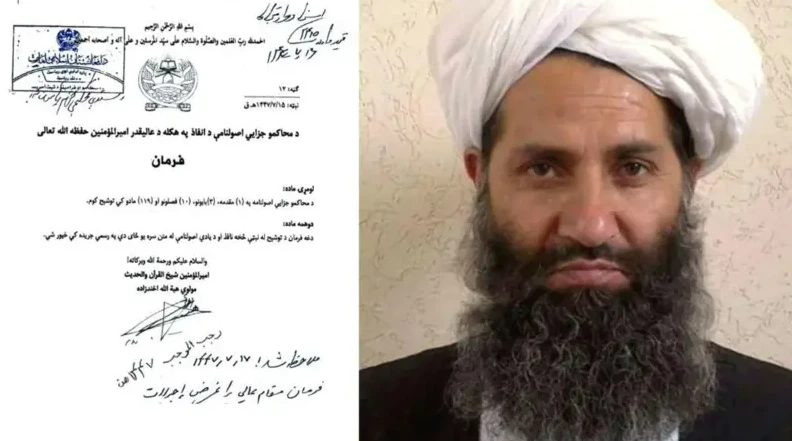
The 61st annual session of the United Nations Human Rights Council, beginning February 27 in Geneva, will include discussion of a newly issued penal code by Afghanistan’s Taliban government, which the council’s commissioner Volker Türk has described as turning Afghanistan into a “graveyard of human rights.”
In the fourth year of their second term in power, Afghanistan’s Taliban authorities have issued a penal code that many both inside and outside the country consider ambiguous, with some sections described as deeply alarming.
Origins and Structure of the Code
The BBC’s Afghanistan fact-finding service has examined the code, which Taliban officials say is entirely based on recommendations from Hanafi jurisprudence. The penal code, signed by Taliban Supreme Leader Hibatullah Akhundzada, consists of three chapters, ten sections, and 113 articles.
Taliban government spokesperson Zabihullah Mujahid told the BBC that these criminal laws were actually implemented during the “20-year war against the United States and its allies” in areas under Taliban control in Afghanistan.
The code grants judges extensive powers unprecedented in Afghanistan’s previous judicial system, including the authority to determine punishments based on the offender’s role and social status. All former judges were dismissed upon the Taliban’s arrival and replaced with their own appointees.
Punishment Based on Social Status
A former judge in Kabul explained to the BBC that in Islamic jurisprudence, “hadd” refers to fixed, predetermined legal punishments that cannot be altered—such as penalties for adultery, false accusation of unchastity, drinking alcohol, and theft. These are called “hadd” because they are determined by Sharia law.
According to Mujahid, their courts will treat all people equally in matters of “hadd” and “rights of the people,” but all punishments beyond these two categories are considered discretionary punishments (tazir), where the sentence varies according to the ruler’s or judge’s opinion, taking into account the defendant’s social role.
Article 4 of the code states that in applying hadd, qisas (retribution), and diyat (blood money), only the crime is considered, not the perpetrator’s personality. However, in discretionary punishments, the “perpetrator’s personality” is taken into account.
Paragraph one of Article 9 classifies punishments based on the individual circumstances of the offender as follows:
- For scholars and high-ranking officials: The punishment is a warning from the judge—essentially informing them that information has been received about their actions.
- For notables, such as tribal leaders and businessmen: Summons to court with notification.
- For the middle class of society: Summons to court followed by imprisonment.
- For the lower class of society: Punishment involving threats and beating, meaning lashes.
Reaction from Former Officials
Afghanistan’s former Attorney General, Mohammad Farid Hamidi, told the BBC that for the past 100 years, all citizens were considered equal under Afghan law. “The Taliban’s code is completely different from Afghanistan’s old legislative tradition.”
He added that “such a division before the law has no place in the contemporary history of Afghan legislation, nor does it align with the values of sacred Islam.” According to Hamidi, “during the time of Prophet Muhammad and the first Caliph, justice was applied equally regardless of people’s status, lineage, social standing, or wealth.”
Scholarly Perspective
A former judge and scholar of Afghan Hanafi jurisprudence, speaking to the BBC on condition of anonymity, said that “the Taliban’s code is based on Hanafi jurisprudence.”
He explained that “in Hanafi jurisprudence, discretionary punishment (tazir) is left to ijtihad, expediency, and the opinion of the ruler or judge, recognizing differences between individuals. A judge can determine the type and amount of discretionary punishment based on the defendant’s condition and public interest.”
According to him, “in Hanafi jurisprudence, sometimes advice is more valuable than lashes for a noble person, and sometimes lashes are the only way to prevent someone from committing a crime.”
Influence of Deobandi Thought
Zabihullah Mujahid maintains that “high-ranking officials in society are not just Taliban government employees. There are others in society who, if they commit a crime, the judge only needs to inform them that information has been received about this matter—their social status does not permit them to do it again.”
Afghan researcher Rustam Ali Seerat told the BBC that “it appears the Taliban scholars are influenced by the Deobandi school of thought in the Indian subcontinent, and the Fatawa-e-Alamgiri, written in India in 1667 under Aurangzeb’s order, has significantly influenced the drafting of this law.”
According to Seerat, “all these issues are influenced by Hindu culture and bear a striking resemblance to the Indian caste system of that time.”
Public Interest and Death Penalty
According to this law, a judge can issue a death sentence if executing criminals might protect “public interest,” such as in cases of corruption, promoting corruption, defending and propagating anti-Islamic beliefs, and practicing witchcraft.
Paragraph two of Article 14 prescribes the death penalty for homosexuality and repeated theft.
Hamidi states that Afghanistan’s 2017 penal code had very limited cases for execution, attached to strict conditions. However, according to him, “the current law entrusts this authority to the judge without any specific conditions, disregarding all accepted criminal and Islamic jurisprudence principles.”
Clause 6 of Article 4 authorizes individuals—apparently including Taliban’s Ministry of Public Order officials and ordinary Taliban personnel—to impose punishments.
The law prescribes death for those insulting Prophet Muhammad and other prophets, and imprisonment for those insulting Taliban leaders and scholars.
Article 15 states that if a Muslim insults Prophet Muhammad or other prophets and the crime is proven, the judge can sentence them to death, and if they repent sincerely, their punishment is less than death.
‘Looking at the Neighbor’s Wife’
Article 34 prescribes discretionary punishment for a woman who goes to her father’s or other relatives’ house without her husband’s permission.
“If a woman repeatedly goes to her father’s or other relatives’ house without a valid reason and without her husband’s permission, and stays there, and despite her husband’s request and the judge’s order does not return, both the woman and the one detaining her will be considered guilty, and each will be sentenced to three months imprisonment.”
Another article states that “if a person has an illegitimate relationship with a non-mahram woman, the judge will sentence them to one year imprisonment.”
Additionally, “looking at a neighbor’s wife, gesturing toward her, describing her body parts, and inquiring about her condition is a crime, and the judge should sentence the guilty person to one month imprisonment.”
Article 59 also prescribes imprisonment for dancing, stating that “boys and girls who dance, and those who watch them, the judge will sentence each to two months imprisonment.”
Taliban government spokesman Zabihullah Mujahid says that “a person who does not provide his wife with her rights such as residence, food, and clothing is also punishable.”
He emphasizes that “the international community should respect Afghanistan’s laws and not question them.”
“Our courts are 100 percent based on Sharia law, and we cannot incorporate foreign civil laws. People who have a problem with Islamic beliefs do not have the right to object,” he said.
Shia Rights and Slavery Terminology
One article, concerning definitions of terms, defines an innovator (bid’ati) as anyone who opposes the beliefs of Ahlus Sunnah wal Jamaah.
However, Mujahid clarifies that “our Shia brothers are not included in this, and Shia have complete freedom in their beliefs and religious worship and do not fall under this order.”
Several articles of this constitution use terminology related to slavery. Article 15 states that discretionary punishment applies to free or slave, man or woman, Muslim or infidel, adult or sensible minor.
Although slavery has been abolished internationally, slavery terminology still exists in some jurisprudence books.
About Author