Australia Commits Half a Billion Dollars to Fast-Track High-Speed Rail Link
By Web Desk :
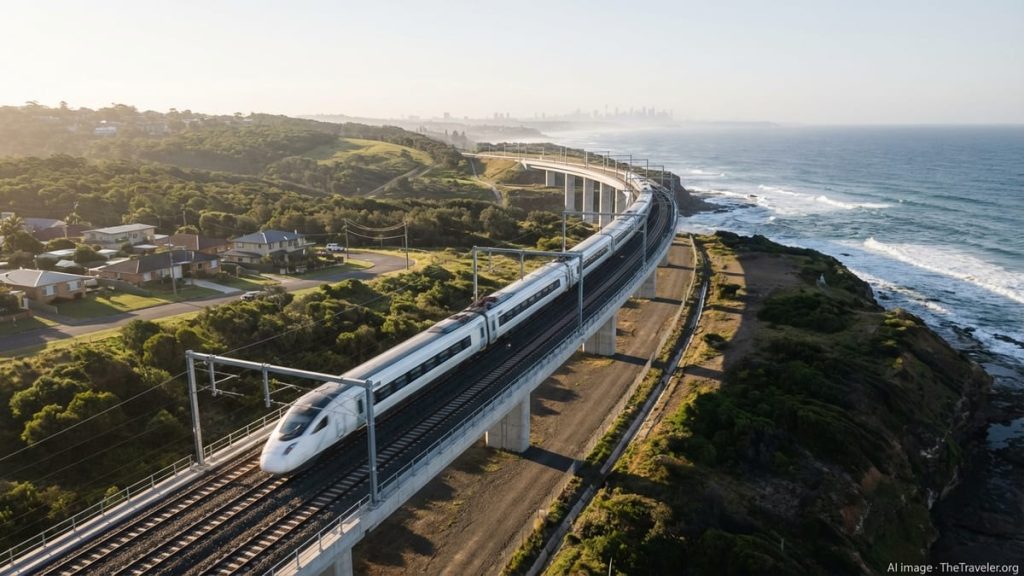
The Australian government has injected more than $650 million into planning for a high-speed rail line between Newcastle and Sydney, advancing what officials describe as the nation’s most serious attempt yet to build a true fast train network.
The funding announcement marks a significant shift from decades of discussions and studies toward concrete engineering, design, and environmental approval work on the 190-kilometre corridor.
Development Phase Funding
Prime Minister Anthony Albanese’s government confirmed on Tuesday it would allocate $659.6 million over two years to prepare the Newcastle to Sydney section for construction. The package includes an additional $229.6 million beyond previously committed funds, bringing the total planning investment to nearly two-thirds of a billion dollars.
Officials say the development phase will involve detailed ground-level assessments along the entire proposed alignment, refining decisions on tunnel placements, station locations, and environmental protection measures. The objective is to present a fully costed, construction-ready proposal for final approval by 2028, allowing major building contracts to be awarded soon afterward.
The Newcastle to Sydney link is designated as Line One of a broader east coast high-speed network, but federal authorities have prioritized this section as the foundation for future expansion. A business case released alongside the funding assesses that the line can deliver faster, more reliable rail services while unlocking housing capacity and employment opportunities across Newcastle, the Central Coast, and Greater Sydney.
Travel Time Transformation
At the core of the project is a dramatic reduction in journey times. Current rail services between Newcastle and Central Sydney often exceed two and a half hours, leaving trains uncompetitive with driving for many trips. High-speed services are expected to cut that travel time to approximately one hour.
The new alignment will largely run through tunnels beneath bushland, waterways, and built-up areas, allowing trains to reach speeds of up to 320 kilometres per hour on less constrained northern sections. Even tunnel segments closer to Sydney, where speeds may be lower, will still deliver significant time savings compared to existing services.
The High Speed Rail Authority’s modelling suggests the line will effectively shrink distances along the New South Wales coast. Travel from the Central Coast to either Sydney or Newcastle would take about 30 minutes, making regional commutes measured in minutes rather than hours.
For passengers, this means far more predictable timetables for business and leisure travel. Tourism operators in both Newcastle and Sydney are already exploring opportunities for same-day visitor experiences, while Central Coast residents could access jobs, education, and cultural events in the capital with unprecedented ease.
Economic and Housing Implications
Government-backed analysis projects the Newcastle to Sydney link could contribute approximately $250 billion to the Australian economy over five decades. These benefits are expected to flow from productivity improvements, new housing development, and job concentration around high-speed stations in Newcastle, the Central Coast, and Sydney.
Regional centres such as Broadmeadow in Newcastle and key Central Coast locations are positioned as major beneficiaries. Faster connections are intended to support higher-density, transit-oriented development, potentially easing pressure on Sydney’s housing market while distributing growth more evenly along the coast.
Federal estimates suggest the broader high-speed program anchored by Line One could sustain nearly 100,000 jobs over several decades, particularly in construction, advanced manufacturing, and specialist engineering. Local suppliers in regional New South Wales are being encouraged to prepare for potential contracting opportunities.
Environmental and Transport Benefits
The business case also highlights climate advantages. High-speed rail is expected to attract passengers away from private vehicles and short-haul flights, reducing transport emissions in one of Australia’s busiest intercity travel corridors. More reliable travel times and frequent services could further encourage behavioural shifts, particularly among regular commuters and business travelers.
Timelines and Funding Questions
Despite the substantial planning investment, significant questions remain about construction timelines and financing. Cost estimates for the initial stage have risen sharply in recent years, with some analyses suggesting the total price tag could reach tens of billions of dollars once extensions to Parramatta and Western Sydney International Airport are included.
The federal government has indicated it will explore a combination of public and private funding options during the development phase but has not yet specified a definitive financing model. New South Wales state leaders have welcomed progress while noting that existing infrastructure commitments limit their capacity for large new contributions in the near term.
Construction timelines extend well into the future. Under indicative staging in the business case, high-speed trains could begin operating between Newcastle and the Central Coast in the late 2030s, with services to Central Sydney and later to Parramatta and the new Western Sydney airport following in subsequent years. Today’s funding announcement effectively lays groundwork for a project that will unfold over decades.
Network Vision
For travelers, the immediate impact will be largely invisible as engineers, planners, and environmental assessors work behind the scenes over the next two years. No new tracks will be laid during the development phase, but critical decisions about station locations, service frequencies, and ticketing integration will be shaped now.
Longer term, the Newcastle to Sydney link is envisioned as the spine of a future high-speed network connecting Brisbane, Sydney, Canberra, and Melbourne. Design choices for Line One, from track geometry to train technology, are being made with these eventual through services in mind, so that a passenger boarding in Newcastle decades from now could ride a single high-speed service all the way to Melbourne.
Travel industry operators are watching closely. A one-hour high-speed rail journey is expected to compete directly with driving and short regional flights, potentially shifting demand patterns for car rentals, domestic airlines, and intercity coach services. Destinations like Newcastle and the Central Coast could benefit from increased short-break visitors from Sydney once the line becomes operational.
Supporters argue that such long horizons are inevitable for infrastructure of this scale and that delaying decisions would only increase costs. Critics question whether successive governments will sustain the political will and financial capacity required to see the project through to completion, particularly if economic conditions tighten.
For now, the project remains at the starting line. The new funding commitment signals that Australia is finally prepared to undertake the detailed work required for true high-speed rail, with the Newcastle to Sydney corridor set to become the country’s proving ground for a faster, more connected future of travel.
About Author