Thermal Drones Emerge as Lifeline in Punjab Floods, Rescuing Hundreds from Rising Waters
Tanveer Ahmed
OKARA – Water stretched out in all directions, darkness was swallowing everything, and hope was fading. Yet, in that desolate scene, a small drone appeared in the sky, its light pulling several lives back from the brink of death.
This was not just a machine; it was a technological miracle that gave hundreds a new lease on life during recent floods in Punjab.
This is a village on the outskirts of Okara, where the roar of floodwaters still echoed. The only refuges were the roofs of houses. On one such roof stood Muhammad Ramadan with his two young children and his wife.
Water was rising every moment, and a wave of fear gripped every heart present. In the distance, there were sounds of rescue teams, but the darkness and noise had swallowed everything.
Suddenly, a faint sound hummed from the sky. It wasn’t a bird—it was a drone, its light pointing directly at their roof. Ramadan and his family thought it was just part of a search operation, but that moment proved to be the difference between life and death.
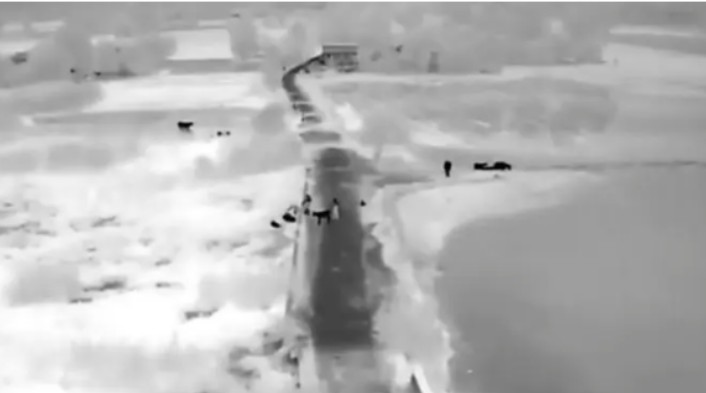
The drone was equipped with a thermal camera capable of detecting human body heat even in total darkness. Within minutes, a rescue team reached them and transported them to safety by boat.
“If it weren’t for this technology, we would have been stuck on that roof all night, and the water might have swept us away,” Ramadan recalled.
This is not an isolated incident. In an area of Jhang, 60-year-old Fatima Bibi was stranded alone on her rooftop. Water had spread everywhere, and visibility was reduced to just a few feet. Rescue teams were scouring villages on foot and by boat but found no trace of her.
Then, a thermal drone detected her body heat. As soon as the signal was received, the team moved straight to her roof and brought her to safety.
“I thought my life was over, but this machine became my new hope,” Fatima Bibi said. These scenes are just two examples of hundreds of such incidents witnessed during this year’s floods.
What Is Thermal Technology?
According to experts, the human body—like any living being—continuously emits infrared radiation, which spreads as heat. The naked eye can’t see it, but thermal cameras capture these signals and convert them into color images. In thermal imaging, warmer areas appear red or yellow, while cooler surfaces are blue or green.
Badar Ali, an expert in security systems, explained: “When these cameras are mounted on drones, they can locate stranded people from the air—even in darkness, rain, or fog. Lack of light or smoke isn’t an obstacle because they rely on heat signatures, not visible light.”
“Thermal cameras not only help rescue teams navigate faster but also ensure their own safety,” he add
This technology isn’t limited to flood zones. Firefighters use it to find people trapped in smoke-filled environments. Security agencies deploy it for night surveillance. In the medical field, it helps detect fevers or abnormal body heat.
Automotive companies are incorporating thermal tech into self-driving cars to detect pedestrians in darkness. There are even devices available that can turn a smartphone into a thermal camera, useful for identifying heat leaks in homes or detecting electrical faults.
In Pakistan, however, the use of thermal technology had previously been confined largely to military and security operations—border monitoring, counter-terrorism, and diagnosing faults in industrial machinery.
There have been limited instances of its use in natural disasters such as earthquakes or fires, but the floods marked its first large-scale application in rescue operations.
Officials say this approach could become a essential part of disaster management in the future.
About Author