Shehbaz Sharif meets US Vice President JD Vance as Islamabad hosts crucial US-Iran negotiations
By Sardar Burhan :
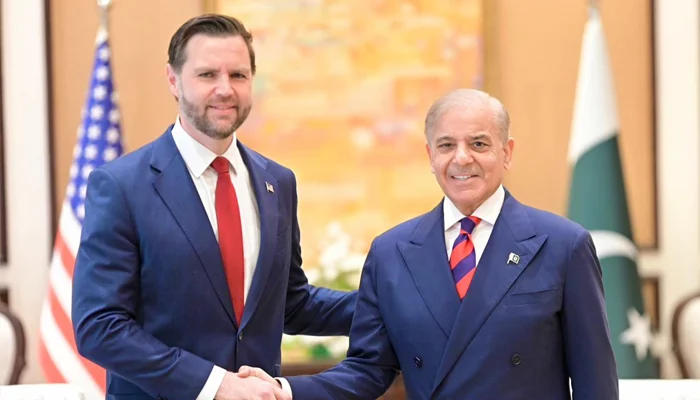
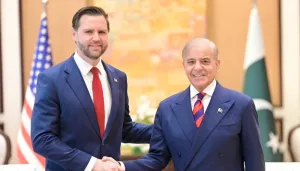
Prime Minister Shehbaz Sharif met United States Vice President JD Vance in Islamabad on Saturday as high-level talks between Washington and Tehran formally began, with hopes the negotiations could pave the way for lasting peace in the Middle East.
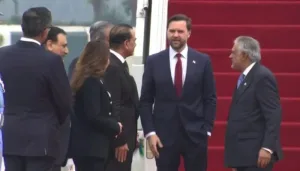
The US vice president arrived with Special Envoy Steve Witkoff and Jared Kushner, son-in-law of President Donald Trump. The Pakistani side included Deputy Prime Minister and Foreign Minister Ishaq Dar and Interior Minister Senator Mohsin Raza Naqvi.
During the meeting, Mr Sharif welcomed the willingness of both delegations to engage in dialogue and expressed hope that the discussions would help move the region towards sustainable stability. He reaffirmed Pakistan’s readiness to continue facilitating communication between the two sides in pursuit of a peaceful resolution.
The meeting followed the arrival earlier in the day of the US delegation led by Mr Vance, which travelled to Islamabad to participate in the negotiations. A senior Iranian delegation headed by Parliament Speaker Mohammad Baqer Ghalibaf had also reached the Pakistani capital ahead of the talks. Iran’s Foreign Minister Abbas Araghchi is part of the delegation and is expected to play a central role in the discussions.
The negotiations come after a two-week ceasefire announced by President Trump following weeks of hostilities triggered by US and Israeli strikes on Iranian targets. Although the truce has reduced immediate tensions, the situation remains fragile, particularly around the Strait of Hormuz and amid continuing clashes involving Israel and the Iran-backed group Hezbollah in Lebanon.
Ahead of the talks, Mr Ghalibaf said progress would depend on Washington fulfilling earlier commitments, including easing restrictions on Iranian assets and supporting a ceasefire in Lebanon. Vice President Vance, meanwhile, expressed cautious optimism about the dialogue but warned that any attempt to derail the process would meet a strong response.
The conflict began on 28 February after coordinated strikes by the United States and Israel targeted Iranian leadership and infrastructure. More than 2,000 people have been killed since then, while Iran responded with retaliatory actions that disrupted shipping in the Strait of Hormuz and targeted US and Israeli interests in the region.
A ceasefire announced on 8 April helped halt the fighting, with Pakistan playing a key role in bringing the sides to the negotiating table. However, major differences remain over a number of critical issues.
Central to the negotiations are competing proposals presented by both countries. The United States has put forward a 15-point framework addressing Iran’s nuclear and missile programmes, sanctions relief and the reopening of the Strait of Hormuz. Iran has proposed a 10-point plan seeking greater control over the strategic waterway, the imposition of transit fees and the removal of international sanctions.
Washington is pressing for firm guarantees that Tehran will not pursue nuclear weapons, including strict limits on uranium enrichment and extensive monitoring by the International Atomic Energy Agency. Iran, however, insists it has the sovereign right to maintain a peaceful nuclear programme, including enrichment activities.
Economic sanctions are another major sticking point. Tehran is demanding the immediate lifting of all US and international sanctions and the release of frozen Iranian assets abroad. The US has instead proposed a gradual easing of sanctions linked to verified compliance with nuclear and security commitments.
Control of the Strait of Hormuz — a key route for global oil shipments — is also under discussion. Iran is seeking formal recognition of its authority to regulate the passage, while the United States insists that international shipping must remain unrestricted.
Regional security concerns are expected to feature prominently as well. Washington wants Iran to end support for allied armed groups across the Middle East, while Tehran is calling for an end to military action against those groups and broader de-escalation of regional conflicts. Iran has also demanded the withdrawal of US forces from the region and a formal pledge of non-aggression.
The talks are being closely watched by the international community, which has broadly welcomed Pakistan’s role in facilitating dialogue aimed at easing one of the most serious crises in the Middle East in recent years.
About Author