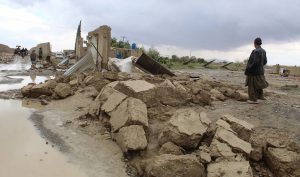
Heavy Rains Kill Dozens in KP and Karachi as Flood Alerts Issued
By Bilal Haider :

Pakistan faced severe weather conditions on Thursday as heavy rainfall caused deaths and widespread disruption in different parts of the country, prompting flood warnings in Khyber Pakhtunkhwa and an emergency declaration in Karachi.
Authorities in Khyber Pakhtunkhwa warned of a growing flood threat after days of intense rain left at least 25 people dead and 77 injured since March 25. The Provincial Disaster Management Authority (PDMA) said the downpours had also damaged more than 80 homes across several districts.
According to the PDMA, casualties and property losses were reported from Bannu, Abbottabad, Kohat, Peshawar, Nowshera, Bajaur, Lakki Marwat, Kurram, Hangu, Shangla, Buner, Malakand, Upper Dir, Battagram, North Waziristan and Tank.
Officials warned that water levels in the Kabul River could rise sharply, particularly near Nowshera, raising the possibility of high-level flooding. Tributaries connected to the river could also overflow, threatening nearby communities.
Flash flood alerts were issued for several waterways including the Kohat Toi, Kurram River and Gomal River, where continuous rainfall and snowmelt could cause sudden surges in water levels. Local administrations in districts such as Peshawar, Nowshera, Charsadda, Mohmand, Bannu, Kohat, Kurram and Dera Ismail Khan have been instructed to remain on high alert and activate emergency response plans.
The Pakistan Meteorological Department has forecast more rain across the province until April 4, raising concerns about further damage and possible casualties.
Authorities also warned about the risk of glacial lake outburst floods in northern areas of the province, saying that rising temperatures and melting snow could swell rivers and streams and threaten low-lying communities.
Residents have been advised to stay away from rivers and streams, while livestock owners have been urged to move animals to safer locations.
At the same time, Karachi was hit by intense rainfall and a hailstorm in some areas, leaving at least five people dead in separate incidents linked mainly to electrocution and building collapse.
Police and rescue officials said four people died after coming into contact with live electrical wires or poles during the rain, while another person was killed when part of a building collapsed in Pak Colony.
Among the victims were a 40-year-old man who suffered an electric shock while trying to repair a fault in Ahsanabad, a 35-year-old man who touched an electric pole in PIB Colony, and a seven-year-old girl who was electrocuted inside her home in Sector 7-A. Another young man died after receiving an electric shock in Hasan Brohi Goth.
The downpour caused widespread flooding on roads and severely disrupted traffic across the city. Rainfall data showed Nazimabad recorded the highest level at nearly 70 millimetres, followed by Kemari and Saadi Town, while several other areas including University Road, Orangi Town and Surjani Town also received heavy rain.
A hailstorm was reported in Mauripur, adding to the intensity of the weather system.
K-Electric said electricity supply was temporarily suspended in some areas as a precaution during the storm but added that the power distribution network remained largely stable. The utility said around 2,000 feeders continued to supply electricity, although about 500 feeders were briefly affected at the peak of the rainfall before being restored.
Heavy rain also triggered severe traffic congestion, with several roads submerged and diversions introduced on key routes including Sharea Faisal. Traffic police reported disruptions on major arteries linking the airport and other central areas.
Karachi Mayor Murtaza Wahab later said traffic flow had largely returned to normal by evening and all underpasses in the city had reopened.
Karachi Commissioner Syed Hassan Naqvi declared a rain emergency as the situation worsened earlier in the day, placing rescue services on high alert. Municipal agencies were deployed across the city to clear drainage channels and remove standing water from low-lying areas.
Emergency camps and help desks were set up in several districts while citizens were advised to contact helpline 1299 in case of emergencies.
Sindh Senior Minister Sharjeel Inam Memon said the provincial government had cancelled leave for essential staff and instructed officials to remain in the field to respond quickly to any situation.
The latest spell of extreme weather highlights Pakistan’s growing exposure to climate-related disasters. In recent years the country has experienced increasingly unpredictable weather, including intense rains, flash floods and heatwaves.
In 2022, record monsoon floods killed more than 1,700 people and affected over 33 million across the country, while heavy rains last year also caused hundreds of deaths and widespread damage, particularly in Punjab.
About Author