Cyber Warfare Emerges as Hidden Front in US-Israel Conflict With Iran
By Tanveer Ahmed :
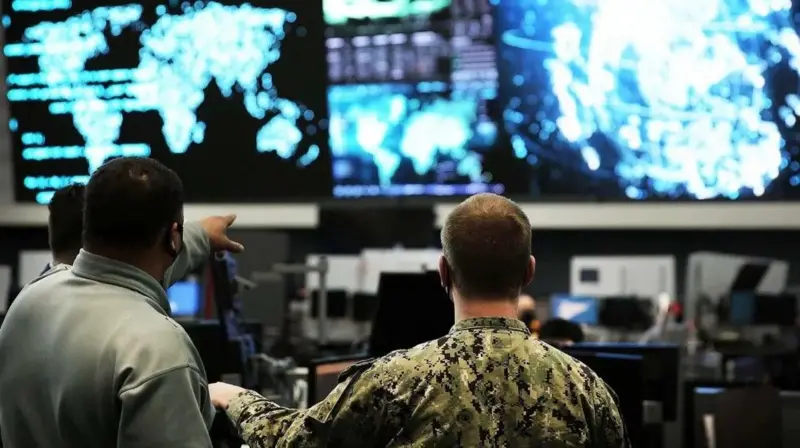
While the United States and Israel have openly showcased their military power in the ongoing conflict with Iran, far less information has been revealed about activities taking place in cyberspace.
Military images and videos released by United States Central Command regularly highlight the jets, ships and weapons being used in the war. However, officials from both countries have remained largely silent about cyber operations.
Despite hours of press briefings, speeches and social media updates, references to cyber warfare have been limited.
Iran-linked hackers claim attack
During the conflict, hackers believed to be linked to Iran claimed responsibility for a cyberattack on the US medical technology company Stryker, marking one of the first prominent cyber incidents associated with the war.
Cyber warfare has played a significant role in the conflict, according to Brad Cooper, who said during a recent briefing that operations against Iran were being conducted “from the sea, air and cyberspace”.
Cyber operations likely began before war
Experts say cyber espionage and hacking often begin long before open conflict. Dan Caine said the campaign against Iran involved months – and in some cases years – of planning to identify military targets.
Analysts believe US and Israeli hackers may have penetrated critical Iranian computer networks well before the first air strikes.
Systems connected to air defence networks or military communications are usually among the primary targets in such operations.
According to unnamed sources cited by the Financial Times, Israeli operatives allegedly hacked surveillance systems, including CCTV and traffic cameras, to track the movements of Ali Khamenei and senior commanders.
Cybersecurity analysts say internet-connected cameras can provide valuable real-time intelligence about movements in cities and around key buildings.
Cyber tools support military operations
Experts say cyber operations rarely act alone but often support traditional military action.
Former Israeli cyber defence specialist Tal Kollender said cyber capabilities typically function as a “force multiplier”, helping shape the information environment and support ground or air operations.
US officials have suggested that cyber units were among the first to act at the start of the campaign. General Caine said personnel from United States Cyber Command and United States Space Command disrupted Iran’s ability to detect attacks, communicate and respond effectively.
Some analysts have speculated that mobile phone networks in parts of Iran may have been jammed during air strikes to prevent security teams from warning potential targets, although such claims remain unverified.
Reports of hacked apps and digital disruption
Israel has also been accused of hacking a popular Iranian prayer-time application called Baad-e-Saba, which has reportedly been downloaded tens of millions of times.
According to reports cited by Reuters, users received a push notification reading “Help has arrived” shortly after bombing raids began.
Cyber tools may also be playing a role in identifying new military targets through open-source intelligence, satellite imagery and digital surveillance.
Artificial intelligence systems are believed to assist analysts in processing large volumes of data to locate potential targets.
History of covert cyber conflict
The US and Israel have a long history of cyber operations against Iran, though details are rarely confirmed publicly.
One of the most well-known incidents was the Stuxnet attack in 2010, which damaged Iran’s uranium enrichment programme.
Israel has also been accused of involvement in a cyberattack on Iranian steel plants in 2022 linked to a group known as Predatory Sparrow.
Cybersecurity experts say governments often avoid revealing details about such operations to prevent exposing their technical capabilities.
Iran’s cyber response remains unclear
One surprising aspect of the conflict is Iran’s limited visible cyber retaliation so far.
The most significant known attack attributed to Iran during the war has been the incident involving Stryker, where hackers reportedly defaced employee login pages and claimed to have deleted company data using destructive “wiper” malware.
Iranian state media later repeated the claim, although the company said it was working to restore affected systems and confirmed that its products remained safe to use.
Despite the relatively limited activity seen so far, analysts warn against underestimating Iran’s cyber capabilities.
Experts say cyber operations may also be carried out by loosely connected “hacktivist” groups whose links to governments are often difficult to prove, making attribution in cyber warfare particularly complex.
About Author