Pakistan Walks Diplomatic Tightrope as Iran–Saudi Tensions Trigger Military Consultations
By Tahir Shah :
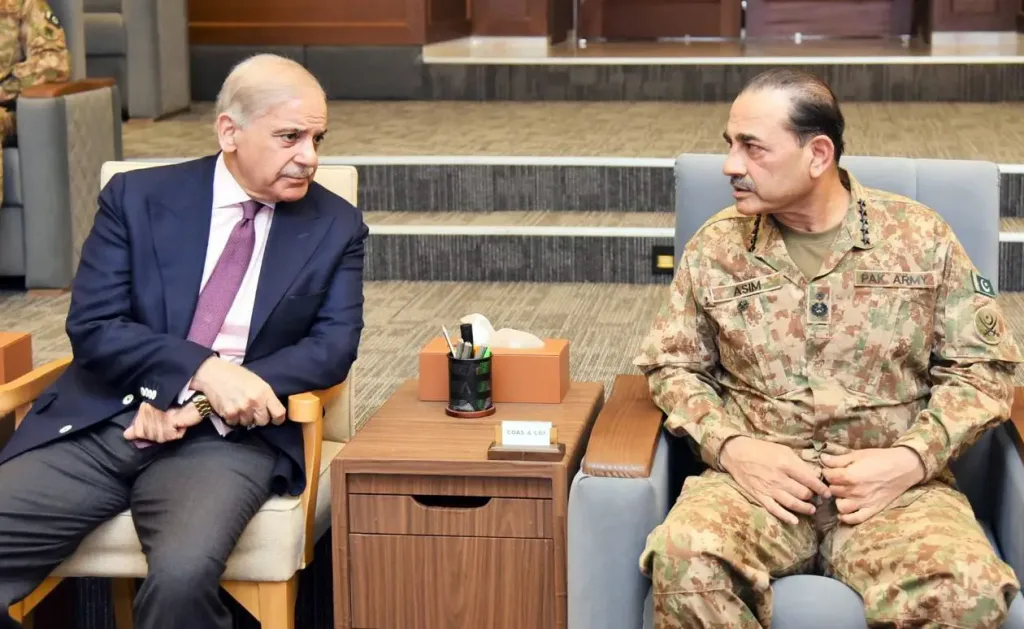
Military consultations between Islamabad and Riyadh following Iranian drone and missile strikes on Saudi territory have underscored the delicate strategic balance Pakistan must maintain as the widening Iran conflict begins to affect the security of Gulf states.
A statement issued by Inter-Services Public Relations (ISPR) after a meeting between the Chief of Defence Forces and Chief of the Army Staff, Asim Munir, and Saudi Defence Minister Khalid bin Salman appeared routine at first glance. However, a closer reading of the language reveals a carefully calibrated diplomatic message from Islamabad.
The Pakistani statement acknowledged the seriousness of the situation arising from Iranian drone and missile attacks on the Kingdom and noted that Munir discussed with the Saudi defence minister measures needed to halt the attacks within the framework of the Strategic Mutual Defence Agreement (SMDA) between the two countries.
The reference signalled solidarity with Saudi Arabia at a time when the Kingdom is facing direct military pressure.
At the same time, the wording of the statement avoided adopting the sharper tone used in Riyadh’s own version of the meeting.
The Saudi statement directly referred to Iranian attacks on the Kingdom and emphasised the need to stop them. By contrast, the Pakistani statement quickly shifted towards a call for restraint and prudence, expressing hope that the “brotherly country” Iran would act wisely and avoid miscalculation.
This difference in phrasing was not accidental. It reflects Islamabad’s long-standing diplomatic instinct to avoid becoming entangled in regional rivalries that could destabilise its own security environment.
Pakistan shares a sensitive border with Iran and must also take into account domestic sensitivities when responding to regional conflicts.
At the same time, Islamabad cannot appear indifferent when Saudi Arabia comes under military pressure.
Relations between Pakistan and Saudi Arabia remain strategically significant in economic, political and defence terms. Over the decades, the two countries have maintained extensive military cooperation that includes training programmes, advisory roles and defence collaboration.
That relationship was formally strengthened last September when both countries signed a mutual defence agreement.
Details of the agreement have not been made public.
As a result, it remains unclear whether the pact applies strictly to attacks on Saudi territory itself or also to third-party installations located on Saudi soil that may become targets during regional confrontations.
The ISPR statement’s reference to discussions taking place within the framework of the SMDA suggests that security consultations are already under way.
This does not necessarily indicate that Pakistan will become directly involved in military operations. However, it does suggest that the defence architecture between the two countries is being activated for coordination and assessment as the situation evolves.
Earlier this week, Pakistan’s Deputy Prime Minister and Foreign Minister Ishaq Dar revealed that he had reminded Tehran of Pakistan’s defence obligations toward Saudi Arabia soon after retaliatory strikes began following what he described as US aggression.
According to Dar, Iranian officials had sought assurances regarding Saudi Arabia’s position, which he said he conveyed to Tehran after securing them from Riyadh.
Despite those diplomatic exchanges, Iran has continued to launch strikes targeting US-linked infrastructure in Saudi Arabia, highlighting the increasingly complex dynamics of the conflict.
The language used in official statements therefore reflects a familiar Pakistani diplomatic strategy: reassuring Saudi Arabia while maintaining caution toward Iran.
In essence, Islamabad is attempting to show solidarity with Riyadh without committing itself to an escalation that could complicate its relations with Tehran.
The message from Pakistan is that while it recognises Saudi security concerns and remains engaged within the bilateral defence framework, it continues to favour de-escalation and hopes the crisis does not spiral into a wider regional war.
This balancing act, however, is becoming increasingly difficult as the confrontation involving Iran and its adversaries spreads geographically and politically.
What initially appeared to be a confrontation largely confined to the shadow conflict between Iran and Israel is now beginning to affect the wider Gulf region.
Missile and drone attacks targeting installations and infrastructure have heightened fears that the conflict could expand into a broader regional confrontation.
For Pakistan, such a development could create significant diplomatic pressure.
If attacks on Saudi territory intensify or draw additional external actors into the conflict, Islamabad may face growing demands to clarify its position within the defence framework it shares with Riyadh.
For now, Pakistan’s approach reflects both caution and necessity.
The country cannot ignore its strategic security partnership with Saudi Arabia, but neither can it afford a deterioration in relations with Iran.
As a result, diplomatic language has become an important instrument through which Islamabad manages both relationships simultaneously.
The Pakistani statement’s reference to Iran as a “brotherly country” is particularly noteworthy.
In diplomatic terms, such phrasing serves not merely as a polite expression but as a signal that Islamabad wishes to keep communication channels with Tehran open and avoid being seen as part of a confrontational bloc.
At a time of rising regional tensions, this wording conveys that Pakistan does not view the current crisis as an opportunity for geopolitical alignment but rather as a situation requiring restraint and careful political management.
In effect, the message is directed at multiple audiences.
To Saudi Arabia, it signals that Pakistan remains attentive to the Kingdom’s security concerns and continues to engage within their strategic defence partnership.
To Iran, it indicates that Islamabad prefers restraint and does not wish the crisis to escalate further.
And to the broader region, it communicates that Pakistan would rather see the confrontation return to political negotiation rather than expand into a wider military conflict.
Ultimately, however, the trajectory of the crisis may depend less on decisions taken in Islamabad or Riyadh and more on how the confrontation between United States and Iran evolves in the coming weeks.
If tensions between Washington and Tehran intensify, the strategic calculations of regional states — including Pakistan may become far more complicated.
About Author