From Precision Strikes to Global Shockwaves
By Sabeeh Zanair :
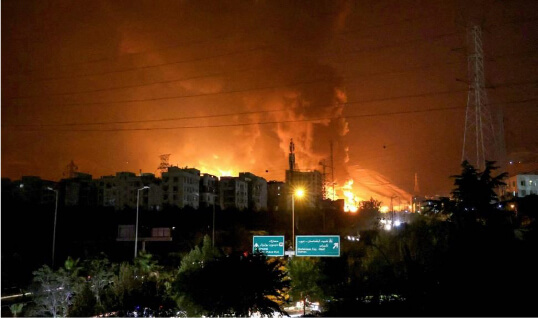
What was presented as a calibrated military operation has, within days, evolved into a confrontation with consequences far beyond the battlefield. The exchange of strikes between the United States, Israel and Iran was framed as limited, strategic and contained. Instead, it has triggered tremors that now stretch from Gulf waters to global trading floors. The battleground is no longer confined to missile trajectories and air defence systems. It now runs through the arteries of the global economy.
At the centre of this widening crisis lies the Strait of Hormuz, the narrow maritime passage between Iran and Oman through which nearly a fifth of the world’s oil and gas supplies transit. For decades, it has been regarded as a chokepoint too vital to close and too dangerous to test. Today, it is both.
Iran’s retaliation has not relied solely on spectacle. Missile strikes targeting U.S.-linked facilities in the Gulf, threats against maritime traffic and disruption near key energy infrastructure suggest a strategy rooted in leverage. If Tehran cannot match Washington’s military reach, it can impose economic cost. And the global economy, already strained by inflationary aftershocks and fragile supply chains, is acutely sensitive to energy shocks.
Markets reacted first with volatility rather than panic — but volatility is often the early warning sign of deeper instability. Brent crude prices climbed sharply. European gas benchmarks surged. War-risk insurance premiums for tankers multiplied, forcing shipping firms to reconsider routes through Gulf waters. LNG shipments slowed as vessels hesitated at the edge of the Strait. Traders began pricing not only immediate disruption, but the possibility of prolonged uncertainty.
For Asia, the exposure is profound. Roughly 70 percent of its imported energy passes through Hormuz. China, the world’s largest energy importer, sources a substantial share of its crude oil from shipments that transit the Strait. India, Japan and Pakistan are similarly dependent. A sustained disruption would ripple across manufacturing output, inflation trajectories and currency stability in emerging markets already balancing delicate growth recoveries.
This is where geopolitics converges with economics. Western capitals quietly hope Beijing may use its influence with Tehran to prevent a prolonged maritime shutdown. Yet China’s calculus is layered. It requires uninterrupted energy flows to sustain domestic stability, but it also observes Washington’s renewed entanglement in the Middle East with strategic patience. A distracted United States alters the balance of global competition in ways that extend beyond the Gulf.
In Washington, official rhetoric has projected confidence. President Trump has suggested Iranian military capabilities have been severely degraded and that operations may continue for weeks. Yet Tehran’s ability to disrupt critical energy routes remains evident. Iranian officials insist their strikes are limited to American assets, signalling controlled escalation even as economic consequences spill across borders.
The structural risk is what unsettles markets most. Modern economies are calibrated to predictability in energy supply. Inflation remains politically combustible across advanced democracies. Central banks that only recently steadied post-pandemic volatility may once again confront price pressures driven not by domestic demand but by geopolitical shock. In Europe, policymakers are watching gas markets with renewed unease. In South Asia, governments are reviewing reserves and contingency frameworks.
History offers sobering precedent. Conflicts launched with confidence in containment often evolve into tests of endurance. The belief that escalation can be finely calibrated has undone policymakers before. Once economic disruption compounds military escalation, exit ramps narrow and political costs compound.
The Strait of Hormuz is barely twenty-one miles wide at its narrowest point. Yet it carries an outsized share of global stability. If insecurity persists whether through blockade, sporadic strikes or sustained insurance fears — the consequences will not remain regional. They will be systemic.
The administration may argue that resolve demands risk. But resolve without foresight is not strength. It is a gamble.
And the world is now holding the chips.
Sabeeh Zanair is a Special Correspondent covering the Middle East, reporting on regional politics, diplomacy, economic developments, and emerging technology trends. With a focus on in-depth analysis and on-ground perspectives, he provides insights into key events shaping the region and their wider global impact.
The writer is a Special Correspondent covering the Middle East, reporting on regional politics, diplomacy, economic developments, and emerging technology trends. With a focus on in-depth analysis and on-ground perspectives, he provides insights into key events shaping the region and their wider global impact.
About Author