Iran’s Supreme Leader Killed in US-Israeli Strikes, Tehran Launches Massive Retaliatory Barrage
By Tahir shah :
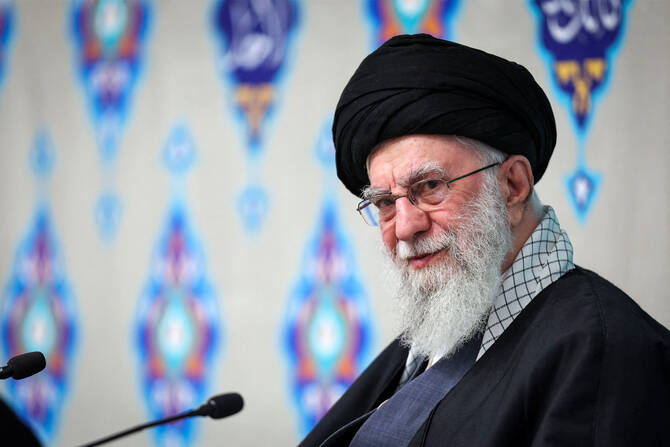
Iran’s Supreme Leader Ayatollah Ali Khamenei has been killed in coordinated American and Israeli airstrikes on Tehran, Iranian state media confirmed Saturday, sending shockwaves through the region and triggering a massive missile response from Iran targeting Israel and Gulf states.
The 86-year-old leader, who held ultimate authority over Iran’s political and military institutions since 1989, died when missiles struck his office compound in central Tehran during what Israeli officials described as the largest aerial campaign ever launched against Iran.
State-linked Iranian news agencies Tasnim and Fars reported that Khamenei “was carrying out his assigned duties and was present at his workplace” at the time of the attack. Several family members, including his daughter, grandchild, daughter-in-law, and son-in-law, were also killed in the strikes, according to Iranian state media.
Multiple Senior Officials Killed
The operation involved approximately 200 fighter jets targeting missile systems, military command centers, and senior leadership positions across Iran. Several high-ranking Iranian officials were also killed, including Defence Minister Amir Nasirzadeh, Revolutionary Guards commander Mohammad Pakpour, and key security advisers Ali Shamkhani and Mohammad Shirazi.
The Times of Israel reported that President Masoud Pezeshkian was also targeted, though his condition remains unclear.
US and Israeli Statements
President Donald Trump confirmed the operation on Truth Social, describing Khamenei as “one of the most evil people in history.” He stated that intelligence systems had tracked the leader’s movements before the operation.
“This is not only Justice for the people of Iran, but for all Great Americans, and those people from many Countries throughout the World, that have been killed or mutilated by Khamenei and his gang of bloodthirsty THUGS,” Trump wrote.
Israeli Prime Minister Benjamin Netanyahu said in a televised address that “increasing signs” indicated the Iranian leader had been killed, adding that Khamenei’s compound in central Tehran had been destroyed.
Iran’s Revolutionary Guards acknowledged the loss, stating: “We are mourning him, a leader who was unique in terms of purity of spirit, strength of faith, resourcefulness in affairs, courage in the face of the arrogant, and jihad in the path of God.”
Iran’s Retaliation
In response, Iran launched a sweeping barrage of missiles and drones targeting Israeli territory and Gulf states hosting US military installations. The Revolutionary Guards announced that “all occupied territories and the criminal US bases in the region have been struck by the powerful blows of Iranian missiles.”
The Israel Defense Forces confirmed multiple waves of missiles fired from Iran, activating defense systems across the country. Sirens blared in Israeli cities, with residents instructed to enter protected shelters. Debris and impact sites were reported in Jerusalem, Beit Shemesh, Tirat Carmel, and several northern communities.
Gulf nations activated air defense systems to intercept incoming missiles. The UAE confirmed it had successfully intercepted several missiles, but debris landed in a residential neighbourhood in Abu Dhabi, killing one person and damaging property. Qatar’s Al Udeid Air Base, the largest US military facility in the Middle East, was targeted, though Qatari defense systems reportedly intercepted the missiles. Bahrain confirmed a service center of the US Fifth Fleet had been struck.
In southern Iran, the governor of Minab confirmed that the death toll from a bombing of a school has risen to 115, intensifying humanitarian concerns inside the country.
The Pentagon stated there were no reported US casualties, and damage to American installations was minimal.
Airspace Closures and Global Impact
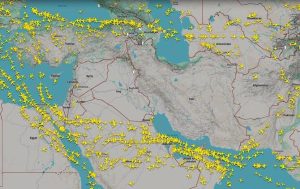
The escalating conflict triggered widespread airspace closures across the region. At least eight states declared their airspace closed, including Iran, Israel, Iraq, Jordan, Qatar, Bahrain, Kuwait, and the UAE. Syria announced it had closed part of its airspace along its border with Israel.
Global airlines suspended flights to affected areas, with major carriers including Emirates, Qatar Airways, and Etihad grounding services. IndiGo and Air India temporarily suspended flights to and from West Asia.
The UN Security Council held an emergency session, with Secretary-General Antonio Guterres warning that the escalating military actions pose a grave threat to international peace and security. Pakistan condemned the attacks on Iran and Gulf states, describing them as violations of international law.
Constitutional Transition
If Khamenei’s death is confirmed, it would trigger a constitutional process for leadership transition. Under Iran’s constitution, a three-person council comprising the president, the head of the judiciary, and a cleric from the Guardian Council would assume control of the country.
The geopolitical fallout is expected to reshape regional power dynamics, energy markets, and global security calculations. Oil markets are bracing for potential disruption through the Strait of Hormuz, through which about one-fifth of the world’s total oil supply passes. Analysts warn that oil prices could surge dramatically if shipping lanes are affected.
Trump has warned that heavy bombing “will continue, uninterrupted throughout the week or, as long as necessary” to achieve “PEACE THROUGHOUT THE MIDDLE EAST AND, INDEED, THE WORLD!” Israeli officials stated that the operation would continue for several days.
With missiles still being exchanged and diplomatic channels strained, concerns are mounting that the conflict could spiral into a broader Middle East war with potentially catastrophic consequences for the entire region.
About Author