Thousands Stranded in Qatar as Airspace Closure Paralyzes World’s Busiest Transit Hub
By Tanveer Ahmed :
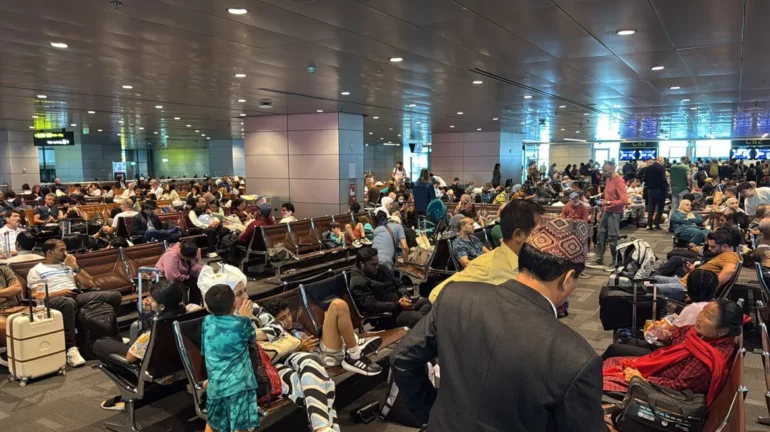
Tens of thousands of travelers found themselves trapped at Qatar’s Hamad International Airport on Saturday after authorities abruptly closed the country’s airspace, shutting down one of the world’s most vital aviation crossroads in response to escalating military conflict between US-Israeli forces and Iran.
The precautionary measure, announced without warning, transformed the sprawling terminal into a sprawling waiting room of confusion and frustration. Arrival halls overflowed with stranded passengers, many of whom had been in transit when their journeys were abruptly halted. Airport screens displayed a relentless cascade of cancellations and indefinite delays as Qatar Airways and other carriers scrambled to respond .
A Global Chokepoint Seized Up
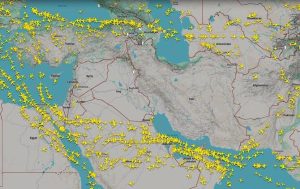
Hamad International Airport serves as a critical transfer point for travelers moving between Europe, Asia, and Africa. The closure forced inbound flights to divert mid-route while scheduled departures remained grounded. Flight tracking platforms showed aircraft rerouting around the Gulf region as Qatar joined several neighbors in sharply restricting overflights amid fears of Iranian retaliation .
Airport authorities confirmed the suspension in a statement shared on social media, explaining the decision was taken in full coordination with government and civil aviation bodies to ensure the safety of passengers, crew, and staff . Hamad International urged affected travelers to stay connected with airline notifications and the airport’s flight status portal for updates .
Qatar Airways Group confirmed the temporary suspension of all flights to and from Doha, stating it was working closely with government stakeholders to support impacted passengers . “Once usual operations resume, we anticipate delays to our flight schedule,” the airline said, adding that additional ground staff had been deployed at Hamad International and other key airports to assist those affected .
Chaos in the Terminal
On the ground, the scene was one of controlled chaos. Families with young children stretched across terminal floors, attempting to sleep near departure gates. Business travelers paced between transfer desks, phones pressed to ears, seeking answers that no one could yet provide. Airport staff directed stranded passengers into makeshift queues while loudspeaker announcements urged calm and promised updates .
Hotel capacity in Doha was quickly exhausted as the scale of the disruption became apparent. By late afternoon, aviation analysts estimated that tens of thousands of people had been affected in Qatar alone, with the ripple effects spreading through major hubs in Europe, South Asia, and Southeast Asia that depend on Gulf transit traffic .
Regional Aviation Meltdown
Qatar was not alone in its response. Across the Gulf, a cascade of airspace closures swept through the region. Kuwait and the United Arab Emirates also suspended operations, effectively severing the primary air bridge between Europe and Asia . The three nations issued Notices to Air Missions citing regional security developments and the need to protect civilian lives from potential missile activity .
Dubai International, the world’s busiest international hub, and Abu Dhabi’s airport suspended operations indefinitely. International carriers including Emirates, Qatar Airways, and Etihad began diverting mid-air flights to alternative hubs in Saudi Arabia, Oman, and Turkey .
Global Ripples
The closures sent shockwaves through global travel and logistics networks. Thousands of flights connecting East and West were canceled or indefinitely delayed. Airlines including Lufthansa, KLM, and Wizz Air announced suspensions of services to multiple destinations across the Middle East . Russia’s transport ministry confirmed that Russian carriers had suspended flights to Israel and Iran .
For travelers in Pakistan, the disruption carried particular weight. A significant portion of Pakistan’s international traffic flows through Dubai and Doha, leaving thousands of overseas Pakistanis stranded at Gulf airports. Pakistan International Airlines adopted a wait-and-see policy, with several Middle East-bound flights held on tarmacs in Karachi and Lahore .
What Comes Next
Hamad International Airport officials reiterated that ensuring safety remains the top priority and thanked passengers for their patience . Regular operations are expected to recommence once authorities deem it safe to reopen the airspace .
For the tens of thousands stranded in Doha’s gleaming terminal, however, patience was wearing thin as the hours stretched on with no clear end in sight. The airport, designed for seamless transit, had become an involuntary waiting room for a world watching the Middle East teeter on the edge of wider conflict .
About Author