Airlines suspend flights amid Middle East airspace closures
By Zeeshan Naseem
A wave of airspace closures across the Middle East has crippled global aviation networks, with Israel, Iran, Iraq, Qatar, and other nations shutting their skies to civilian traffic following joint US-Israeli military strikes on Iran.
The escalating conflict has forced major international airlines to suspend flights, reroute long-haul services, and cancel hundreds of departures, leaving thousands of passengers stranded and sending shockwaves through the travel industry.
Nations Shut Their Skies
Israel, Iran, Iraq, and Jordan closed their airspace immediately after the strikes began early Saturday. Qatar, Bahrain, Kuwait, and the United Arab Emirates followed with partial or full closures as a precautionary measure, citing regional security developments.
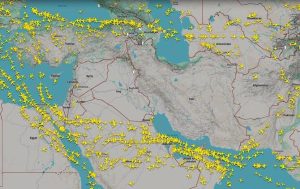
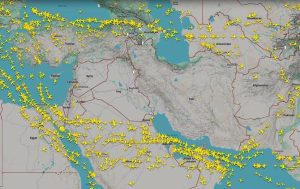
Flight tracking platforms showed the skies over Iran and Iraq virtually empty, creating visible blank zones on global flight maps. The UAE’s civil aviation authority announced a temporary and partial closure of its airspace, disrupting operations at Dubai International Airport—the world’s busiest hub for international passenger traffic—and Al Maktoum International Airport.
Major Airlines Suspend Operations
Emirates, the region’s largest carrier, halted all flights to and from Dubai, citing multiple regional airspace closures. The airline urged customers to check its website for updates and apologized for disruptions, emphasizing that passenger and crew safety remains its highest priority.
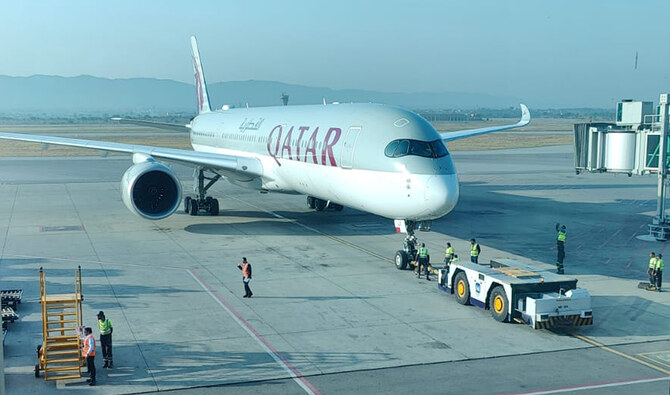
Sister carrier flydubai also suspended operations, while Air Arabia canceled flights across its UAE bases in Abu Dhabi, Sharjah, and Ras Al Khaimah. Qatar Airways confirmed it had temporarily halted air traffic, warning passengers to expect delays once normal operations resume.
European carriers moved quickly to adjust schedules. Lufthansa suspended flights to and from Dubai for the weekend and halted Tel Aviv, Beirut, and Oman routes until March 7. Air France canceled services to Tel Aviv and Beirut, while KLM brought forward the suspension of its Amsterdam–Tel Aviv route.
Wizz Air announced an immediate suspension of flights to Israel, Dubai, Abu Dhabi, and Amman until March 7. Norwegian Air Shuttle suspended all Dubai services until March 4.
Turkish Airlines canceled flights to Lebanon, Syria, Iraq, Iran, and Jordan until March 2, along with services to Qatar, Kuwait, Bahrain, the UAE, and Oman scheduled for February 28. Low-cost carriers Ajet and Pegasus followed with similar cancellations.
Asian Carriers Hit Hard
Indian airlines faced significant disruption. Air India diverted its Delhi–Tel Aviv flight back to Mumbai and suspended all Middle East services. IndiGo issued a travel advisory canceling all flights to and from the region until midnight, urging passengers to check flight status before departure.
Pakistan International Airlines suspended its Middle East flights on Saturday, leaving thousands of overseas Pakistanis stranded at Gulf airports.
Economic Impact Mounts
Aviation data research firm Cirium reported that of 3,422 scheduled flights to Israel, Iran, Saudi Arabia, Oman, Bahrain, the UAE, Qatar, and Jordan, 232 flights—nearly seven percent—were canceled on Saturday alone. Israel saw the highest cancellation rate at over 37 percent, followed by Jordan at 13 percent and Qatar at 10 percent.
With Russian and Ukrainian airspace already closed to most airlines due to the ongoing war, the Middle East had become an increasingly vital corridor for Europe-Asia traffic. The new restrictions are forcing airlines to take longer detours south over Saudi Arabia or north via Central Asia, increasing flight times by one to three hours and substantially raising fuel costs.
“If disruptions remain short-lived the impact is manageable,” said Linus Bauer, head of UAE-based consultancy BAA & Partners. “If airspace avoidance persists, airlines face structurally higher operating costs, weaker aircraft utilisation and profit margin pressure especially on long-haul networks reliant on Middle East transit corridors.”
China’s Civil Aviation University estimated that 28 percent of intercontinental flights now require rerouting, with significant implications for airlines already operating on thin profit margins.
Safety Warnings Issued
Europe’s aviation safety regulator, EASA, issued a Conflict Zone Information Bulletin warning of high risk to civil aviation in the affected airspace. The agency advised airlines to avoid operating in the region, citing risks of retaliatory actions that could inadvertently threaten civilian aircraft.
Virgin Atlantic announced it would temporarily avoid Iraqi airspace, resulting in rerouted flights and the cancellation of its Saturday London–Dubai service.
Passengers Face Uncertainty
At Dubai International Airport, once-busy terminals stood nearly empty as flight after flight appeared canceled on departure screens. The Dubai Media Office advised passengers not to travel to the airport and to contact airlines directly for updates.
In Doha, Hamad International Airport filled with stranded travelers as Qatar Airways flights circled over Kuwait and Saudi Arabia before returning to Qatari airspace. Hotel capacity in both cities was quickly exhausted.
About Author