Modi Lands in Israel for Strategic Talks Amid Domestic Criticism Over Gaza
By Tahir Shah :
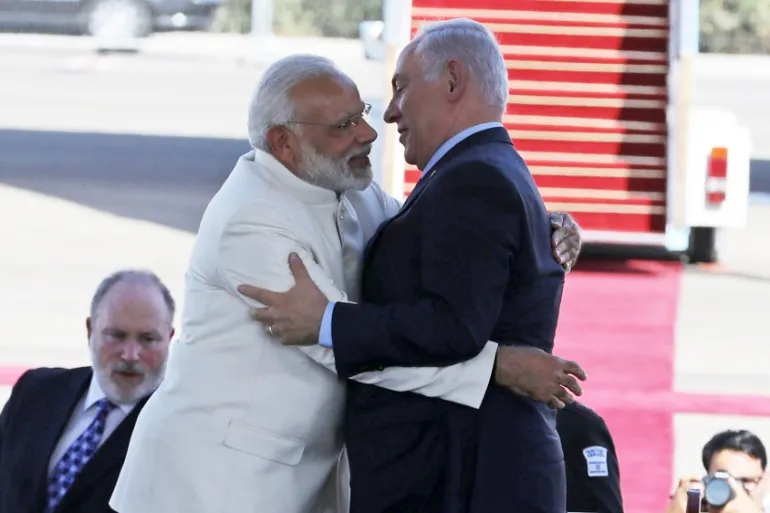
Indian Prime Minister Narendra Modi arrived in Israel on Wednesday for a two-day state visit aimed at deepening defence and trade ties, even as opposition leaders at home accused him of abandoning the Palestinian cause and displaying moral cowardice by engaging with Israeli leadership during the ongoing Gaza crisis.
Modi was received at the airport by his Israeli counterpart Benjamin Netanyahu and his wife Sara, with the two leaders holding a one-to-one meeting shortly after arrival. The visit marks Modi’s second trip to Israel since 2017 and comes at a time when bilateral ties are poised for a significant upgrade.
Elevating Strategic Partnership
According to sources familiar with the discussions, India and Israel are expected to elevate their relationship to a special strategic partnership during the visit, a status comparable to Jerusalem’s ties with the United States and Germany. The upgraded framework would allow for joint development of advanced defence systems and formalise an understanding to stand by each other in times of need.
In a departure statement, Modi described the bilateral relationship as a robust and multifaceted strategic partnership that has witnessed remarkable growth in recent years. He expressed confidence that the visit would further consolidate enduring bonds between the two nations and advance their shared vision for a resilient, innovative, and prosperous future.
Comprehensive Agenda
The prime minister is scheduled to address the Knesset, Israel’s parliament, becoming the first Indian leader to do so—a rare honour extended to select world leaders. He will also meet Israeli President Isaac Herzog and pay respects to victims of the Holocaust at Yad Vashem.
On Wednesday evening, Netanyahu is hosting a private dinner for Modi, followed by an exhibition showcasing Israeli technological innovation with top executives in attendance. The two leaders are expected to hold bilateral talks on Thursday covering defence and security, trade and economy, science and technology, innovation, agriculture, and water management.
Defence Cooperation Deepens
The visit builds on significant momentum in defence ties. Earlier this month, India and Israel signed a Memorandum of Understanding to deepen defence cooperation, following a Joint Working Group meeting in November that enabled sharing of advanced technology for co-development and co-production.
The International Defence Cooperation Directorate within Israel’s Ministry of Defense facilitated meetings between Indian and Israeli defence companies, with both sides emphasising their commitment to advancing bilateral dialogue and cooperation between industries that have stood shoulder to shoulder in times of crisis.
Local media has reported that understandings are being established in areas such as air defence systems, including potential integration of India into Israel’s laser-based air defence system.
Free Trade Agreement Talks Underway
The visit coincides with the first round of negotiations for an India-Israel Free Trade Agreement, which commenced in New Delhi on Monday. Commerce Secretary Rajesh Agrawal underscored that the talks are taking place at a significant moment, with opportunities available in innovation, science and technology, artificial intelligence, cybersecurity, high-tech manufacturing, agriculture, and services.
Former Israeli Ambassador to India, Daniel Carmon, expressed confidence in the negotiations, noting a significant shift in India’s approach to FTAs under Minister Piyush Goyal’s leadership. He expressed hope that Israel would soon stand together with all those important countries as a good friend of India.
Total merchandise trade between the two countries stood at $3.62 billion in 2024-2025, though this represented a decline from previous years. India’s exports to Israel fell while imports also dropped during the period.
Domestic Political Firestorm
While the government has projected the visit as a push to strengthen an innovation-driven strategic partnership, the opposition has made Modi’s Israel outreach a domestic political flashpoint, highlighting India’s historic support for Palestine and the humanitarian crisis in Gaza.
Congress general secretary Jairam Ramesh launched a scathing attack, alleging that Modi was brazenly embracing Netanyahu despite global outrage over Gaza. He suggested that when the entire world is critical of his dear friend Mr. Netanyahu, Modi would be displaying moral cowardice.
He recalled India’s historical support for Palestine, noting that Jawaharlal Nehru visited Gaza in 1960, India issued a commemorative postage stamp in solidarity with Palestine in 1981, and formally recognised the state of Palestine in 1988.
Congress general secretary Priyanka Gandhi Vadra expressed hope that Modi would mention the killing of thousands of innocent men, women and children in Gaza during his address to the Knesset and demand justice for them. She asserted that India has stood for what is right throughout its history as an independent nation and must continue to show the light of truth, peace and justice to the world.
Regional Balancing Act
The visit unfolds against a backdrop of heightened regional tensions, with Iran and the United States expected to hold new talks in Geneva on Thursday over Iran’s nuclear programme. The Pentagon has mobilised military assets in the region, adding complexity to the strategic landscape.
Carmon acknowledged that the Gaza conflict may come up during discussions but stressed that no concrete outcomes such as mediation were expected, with the primary focus remaining on strengthening bilateral ties.
India maintains a delicate balancing act in the Middle East, cultivating strong relations with Gulf nations and Tehran while deepening ties with Israel. New Delhi is developing Iran’s Chabahar port as a trade gateway to Afghanistan, where it has built a relationship with Taliban authorities, and remains part of the India-Middle East-Europe Economic Corridor concept first announced at the G20 in 2023.
Economic and Technological Horizons
Several Memorandums of Understanding are expected to be signed during the visit, with a particular emphasis on disruptive technologies such as artificial intelligence, quantum computing, and cybersecurity. A secrecy mechanism will be established that opens new categories of defence cooperation previously unavailable.
The Bilateral Investment Agreement signed in September 2025, designed to provide greater certainty and protection for investors, has laid groundwork for enhanced economic engagement.
Agriculture remains one of the oldest and most practical pillars of the relationship, with dozens of Centers of Excellence established across India working on food security, seeds, and post-harvest technologies.
Looking Ahead
Modi is scheduled to interact with members of the Indian diaspora in Israel before departing Thursday evening. The Ministry of External Affairs stated that the visit will reaffirm the deep and long-standing strategic partnership between the two countries and present an opportunity to review common challenges while realigning efforts toward their shared vision.
As one Israeli editorial noted, the relationship has trust, history, and political chemistry, but also a recurring weakness of under-execution relative to potential. The challenge for both leaders will be to build scale and translate frameworks into practical wins that matter long after the headlines fade.
About Author