Unusual Winter Heat in Northern Pakistan Raises Risk of Catastrophic Glacial Floods
By Sadia Khan :
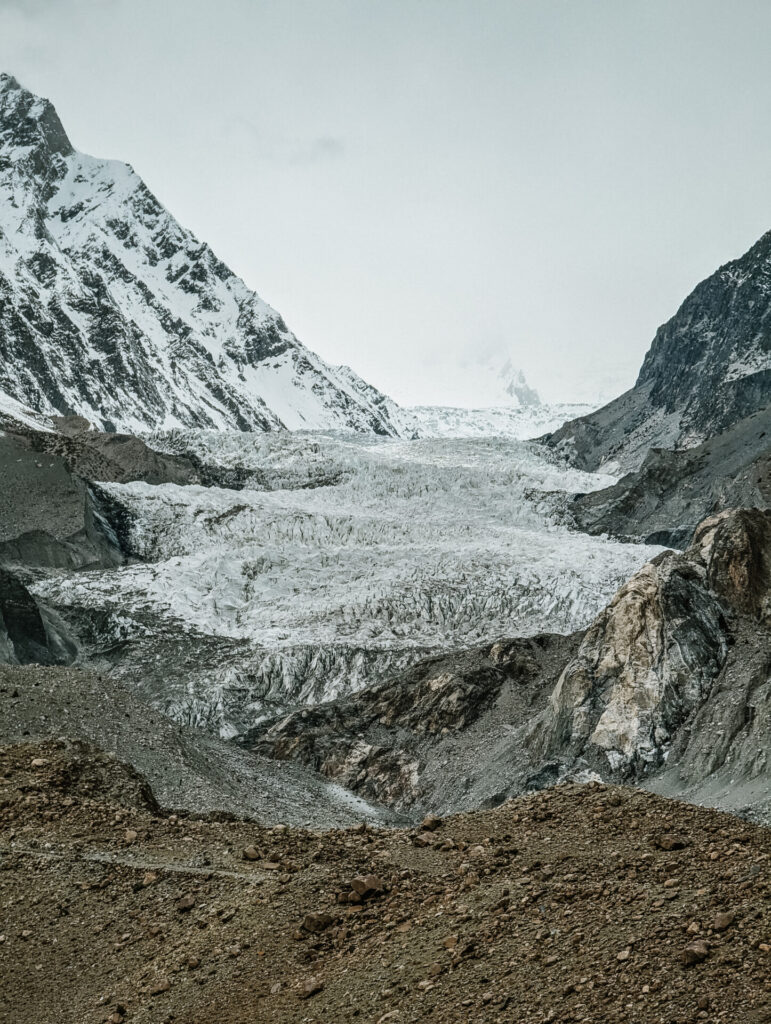
Authorities have issued urgent warnings to communities in Pakistan’s mountainous north after an unusually warm winter triggered accelerated glacial melt, dramatically increasing the threat of sudden and destructive flooding.
The Pakistan Meteorological Department (PMD) reported Monday that daytime temperatures across Gilgit-Baltistan soared 3 to 5 degrees Celsius above normal during the first three weeks of February, while nighttime readings remained 1 to 3.5 degrees warmer than the historical average.
This sustained heat, coupled with below-average snowfall and persistent clear skies, is rapidly melting glaciers at mid and lower altitudes, according to the department’s latest assessment.
Dangerous Lake Formation
Scientists warn that reduced overnight cooling is limiting crucial refreezing cycles, allowing larger volumes of meltwater to accumulate in glacial lakes. Both moraine-dammed and glacier-dammed lakes are swelling, raising the probability of Glacial Lake Outburst Floods (GLOFs)—sudden releases of water and debris that can devastate downstream communities.
The worst warming has been recorded in Gilgit and Bunji, while Chilas and Bunji have experienced notable increases in minimum temperatures, further accelerating the melting process.
Vulnerable Valleys at Risk
The PMD’s outlook for February through April predicts above-normal temperatures will persist across northern Pakistan and Kashmir. Areas identified as most vulnerable include Gilgit, Ghizar, Hunza, Bunji, Chilas, and Astore.
Pakistan is home to more than 13,000 glaciers—the largest concentration outside the polar regions—but experts estimate approximately 10,000 glaciers in Chitral and Gilgit-Baltistan are already receding due to climate change-induced warming.
Changing Weather Patterns
Local observations confirm a troubling shift in seasonal rhythms. Khadim Hussain, director of the Gilgit-Baltistan Environmental Protection Agency, noted that snowfall has increasingly shifted to mid-January and February over the past three years, reducing the time available for snow to compact and transform into glacial ice.
“Late snowfall does not compact and can melt rapidly when the summer season starts, which increases the risk of floods downstream,” Hussain explained.
Residents report that temperatures remained unusually high through December, with meaningful snowfall only arriving in late January—a pattern that has raised concerns about summer flooding potential.
Human Cost
The threat is not hypothetical. More than 7.1 million people in Gilgit-Baltistan and Khyber Pakhtunkhwa are vulnerable to GLOF events, according to the Ministry of Climate Change . Last summer, rapidly melting glaciers and cloudburst incidents severely affected communities across the region .
Between 1987 and 2013, the average temperature in Gilgit-Baltistan rose by approximately 0.6 degrees Celsius—a trend that has accelerated in recent years.
Monitoring and Response
The meteorological department stated it is closely monitoring temperature trends, glacier melt conditions, and hydrometeorological parameters, promising to issue timely advisories to authorities and at-risk communities .
For residents living downstream from glacial lakes, the coming months may bring difficult decisions about safety and preparedness as Pakistan’s northern mountains continue their unprecedented thaw.
About Author